
Review of Afghanistan developments
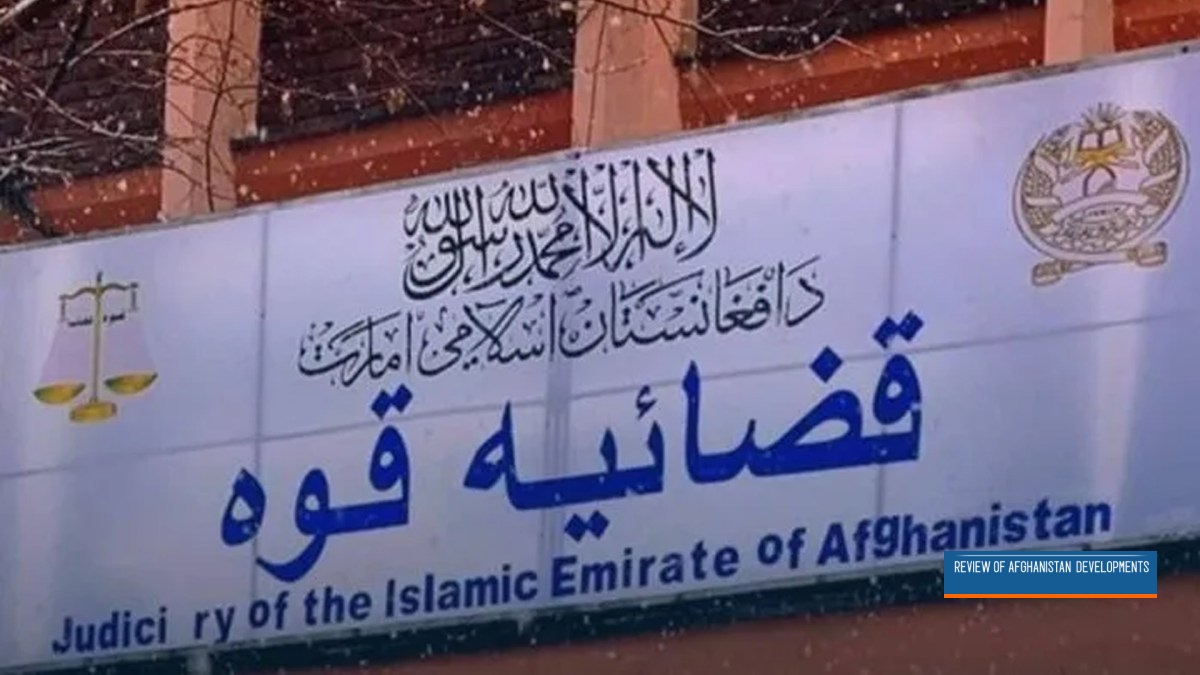
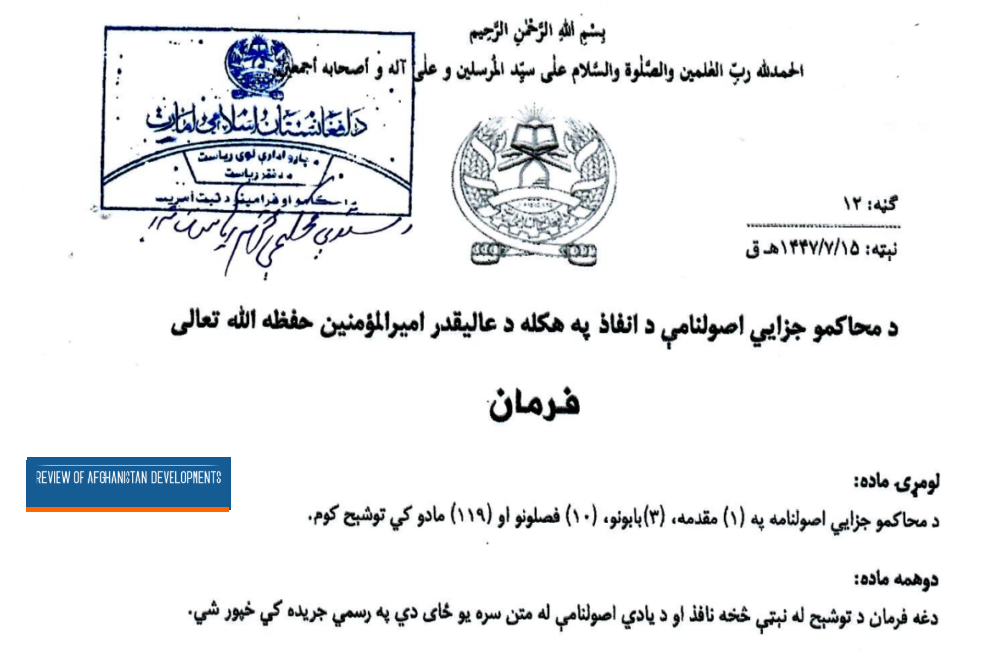
Following the Taliban’s return to power in Afghanistan, Taliban government annulled the nation’s previous laws, establishing Islamic Sharia—specifically Hanafi jurisprudence—as the sole foundation for legislation. Within this framework, the Criminal Code of Courts was recently promulgated under the directive of the Taliban’s supreme leader, Mullah Hibatullah Akhundzada. This legal document, structured with an introduction, three chapters, and 119 articles in Pashto, aims to govern the penal system within the government’s judiciary. Its issuance marks a formal effort to codify criminal law according to the Taliban’s jurisprudential interpretation.
Despite its foundational role, the Criminal Code of Courts has yet to undergo systematic scientific or professional scrutiny. Prevailing responses in media and political discourse have been largely emotional or politically charged, dominated by human rights critiques. This analysis seeks to depart from those approaches, intending instead to evaluate the Criminal Code of Courts from a structural, jurisprudential, and legal perspective, focusing on its text and inherent logic rather than external political conflicts.
Criminal Code of Courts within the Context of Traditional Jurisprudence and Modern Interpretations
Certain rapid critiques of the Criminal Code of Courts have sought to emphasize concepts that seem scientific, albeit in a superficial and restricted manner, neglecting to provide a coherent analysis of the theoretical framework and jurisprudential principles that underpin the text. These perspectives predominantly stem from Western viewpoints and have given insufficient regard to the internal logic of the text and its epistemological premises.
In several of these critical analyses, the terminology and concepts prevalent in classical jurisprudence have been portrayed as indicators of a traditional perspective that conflicts with the demands of the modern world; meanwhile, the Taliban government has characterized itself as a regime grounded in religious interpretation and has clearly stated that its laws and regulations are founded on traditional jurisprudence, particularly Hanafi jurisprudence. Within this context, it is to be expected that the language, literature, and concepts employed in the criminal statutes of the courts will similarly mirror this jurisprudential tradition.
Divisions such as the separation between slave and free, male and female, as well as infidel and Muslim, represent concepts that are established in the literature of traditional jurisprudence. These distinctions are also prominently featured in the writings and declarations of hadith leaders and early Islamic scholars. When a legal text references these principles, the propositions are cited in full and without alteration. The rationale for this citation necessitates that these concepts remain included, regardless of their alignment with modern sensibilities.
Regulations of the Criminal Court and Swift Political Critique
In contrast to civil law, criminal law and jurisprudence possess a distinct nature and exhibit greater sovereignty; consequently, within the traditional classification of law, criminal law falls under the category of public law. A key feature of public law is the significant and decisive role played by the state, with the exercise of public authority being directly evident.
Likely as a result of this characteristic, the Taliban government’s criminal code of courts has encountered swift and impulsive criticism from various institutions and political figures shortly after its release, instead of undergoing thorough technical and expert evaluations.
An examination of these criticisms reveals that a considerable number of them stem from preconceived notions rather than from a thorough analysis of the text, structure, and legal principles underlying the Code of Criminal Procedure. In certain instances, particular issues have been emphasized or even invented due to the prevailing media environment and based on broad human rights assertions, without a definitive connection being made to the specific stipulations of the Code of Criminal Procedure of the Courts.
The Criminal Code of Courts and the Importance of Objective and Scientific Critique
The ongoing politicization of legal matters subjects’ public opinion to emotional influences and restricts the potential for scientific and foundational reasoning. The character of the criminal code utilized by the courts of the Taliban government represents a fundamentally scientific concern that requires examination and critique through the lenses of jurisprudence, legal principles, and criminology, with political emotions being inadequate substitutes for thorough analysis.
While the Taliban government’s approach to governance, particularly in the judicial domain, is rooted in Islamic jurisprudence and Hanafi theology, there have been few instances of critics addressing the government’s worldview, legal principles, and political theology through a scholarly lens. Consequently, without a scientific challenge to the intellectual underpinnings of the Taliban government, numerous political demands and critiques have diminished in their effectiveness and influence, leading to a perception that there is a lack of precise comprehension regarding the essence of the Taliban and the actual circumstances in Afghanistan.
On the other hand, the newness of this legislation and the insufficient duration that has elapsed may have restricted the potential for coherent scientific critique; something that can be expected to be partially compensated for in the future and over time.
Criminal Code of Courts and the Status of Shias in Afghanistan
In light of the release of the Criminal Code of the Courts, many adversaries of the Taliban regime have sought to emphasize the religious discord between Shiites and Sunnis. While it is true that during the republican period, Afghanistan’s criminal legislation was also grounded in Hanafi jurisprudence, the legal text indicated that the criminal regulations concerning hudud, qisas, and diyat were derived from Hanafi jurisprudence. Furthermore, according to Articles 130 and 131 of the former constitution, Shiite jurisprudence was applicable to matters concerning Shiite individuals. In all other civil issues, the courts adhered to civil law, which was fundamentally based on Hanafi jurisprudence.
The primary distinction between the present circumstances and the republican era lies in the fact that the legal framework of the republican era was founded on consensus and collective will, rather than a unilateral decision by the government. This foundation fostered religious empathy, unity, and coexistence within Afghanistan.
The previous constitution has been declared abrogated, creating ambiguity concerning the role of Jafari jurisprudence within the new judicial framework. Coupled with the limitations imposed on the teaching of Jafari jurisprudence in academic institutions, this situation has undermined the foundation for religious unity and cohesion, thereby facilitating a conducive environment for negative propaganda. For instance, interpretations found in Article 2, Section 8 of the Criminal Code of Courts categorize followers of Sunnis and Jamaat as ‘true Muslims,’ while labeling others as ‘innovators.’ According to the definition provided at the outset of this law, an innovator is defined as an individual whose beliefs contradict those of Sunnis and Jamaat. Such interpretations may contribute to the erosion of religious unity and exacerbate media scrutiny directed at the Taliban government.
Criminal Code of Courts and Basic Legal Principles
From a legal standpoint, the conventions of writing, and legal literature, the text and organization of the Criminal Code of Courts are fraught with writing mistakes. Terms like “insulting the officials of the Islamic Emirate,” “corruption,” “rebel,” and similar expressions are employed in a broad and ambiguous way, leading to interpretations and applications that are at odds with the essential principles of a fair trial and several established legal and jurisprudential norms.
This document does not explicitly acknowledge several fundamental principles, including the equality of individuals before the law, the presumption of innocence, the prohibition of torture, the prohibition of arbitrary detention, the right to access legal counsel, the right to remain silent, and the right to an effective defense.
Furthermore, the inability to establish minimum and maximum penalties, along with the heavy dependence on “confession” and “testimony” as primary methods for proving a crime, without the inclusion of independent investigation mechanisms, heightens the potential for abuse and infringements on the rights of the accused. Additionally, certain provisions of this code of principles exhibit resemblances to the criminal laws from earlier periods regarding their security approach, which may impact the equitable enforcement of the law.
Criminal Code of Courts and the Necessity of Paying Attention to Legal Principles
The experiences and principles associated with legal writing necessitate that the language of the law be crafted in a manner that is comprehensible to the general public, while also avoiding vague, general, and ambiguous terms. Such ambiguities can lead to varied interpretations, misuse, and personal biases. Furthermore, restricting the legal text to a single language diminishes the breadth of public access and comprehension.
In the Criminal Code of the Courts, the functions and authority of entities like the police, the public prosecutor’s office, and judicial officers are not distinctly delineated, and the document’s nature is such that it consolidates both substantive and procedural rules in a concise manner. Furthermore, an overemphasis on penalties, lacking a clear distinction from other criminal sections, may diminish the efficacy of the criminal justice system.
It is important to highlight that concepts such as equality under the law, the presumption of innocence, the right to a fair trial, and the ban on torture are not merely requests from civil and human rights organizations. Instead, they are deeply rooted in the philosophy of legal rulings, Islamic criminal law, the tenets of Islamic jurisprudence, ethical conduct, and morality. These deficiencies can be addressed through academic research. Historical experiences in law formulation also demonstrate that engaging public opinion and the shared principles of Islamic jurisprudence can enhance legal consistency.
Criminal Code of Courts: A Step Towards the Rule of Law
Notwithstanding academic critique and the necessity to embrace it for the enhancement of legal frameworks, the issuance of the Criminal Court Rules can be perceived from a different perspective. Initially, the Taliban administration has sought to assemble this document with a fairly organized format, distinct chapter separations, citations of legal sources, and a meaningful methodology; which suggests a movement towards codified legislation and a departure from solely oral practices.
Secondly, it has been demonstrated through experience that the rule of law, despite its imperfections, limits the influence of personal bias and fortifies the principles of law more effectively than verbal regulations. Viewed in this light, the advancement of the courts’ criminal code may be regarded as a preliminary, though inadequate, measure in the process of institutionalizing legal frameworks; a trajectory that, as the political climate calms and the governance framework becomes more stable, can progressively shift towards more scientific methodologies.
Related Articles
Taliban Government Four Years After Coming to Power
Implications of the ICC’s measures against the Taliban leader
Conclusion
The Criminal Code of Courts established by the Taliban regime is a document crafted within the parameters of traditional Hanafi jurisprudence, showcasing the regime’s unique interpretation of Islamic law. Thus far, responses to this document have predominantly been political and emotional, with minimal scientific or jurisprudential examination. In addition to academic criticism and apprehensions regarding fair trial principles, the initiative to create a codified code can be viewed as a preliminary move towards establishing the rule of law. A thorough evaluation of this set of rules necessitates a systematic and scientific critique that aligns with the theological and jurisprudential principles that underpin it.