
Review of Afghanistan developments
Recent remarks by Paul Kapur, Assistant Secretary of State for South and Central Asian Affairs, regarding the formulation of a new US policy toward Afghanistan have renewed debate about Afghanistan’s position within Washington’s broader foreign policy architecture. This reassessment has emerged in parallel with the absence of Afghanistan from the most recent United States National Security Strategy, a development that led some observers to conclude that the country had been deprioritized in American strategic thinking.
The central question, therefore, concerns the direction of US policy toward the Taliban-led government in Afghanistan. Will Washington pursue a policy centered exclusively on containment of security threats, or will it gradually move toward a calibrated form of engagement? This question must be examined in light of the United States’ two-decade involvement in Afghanistan, the domestic and international constraints shaping policy options, and the evolving regional environment.
The United States’ extended intervention, aimed at state-building and institutional reconstruction, generated significant political, financial, and strategic costs. These experiences have narrowed the range of viable policy instruments available to Washington. At the same time, Afghanistan continues to present security, humanitarian, and geopolitical considerations that prevent complete disengagement. Accordingly, current US policy toward Afghanistan is structured primarily around mitigating threats to American interests while maintaining strategic flexibility.
Domestic Dimensions of US Policy Toward Afghanistan
Counterterrorism and the Prevention of Safe Havens
At the domestic level, the foremost objective of US policy toward Afghanistan is to prevent the country from re-emerging as a sanctuary for transnational terrorist organizations. Central to this concern is the presence and operational capacity of Islamic State – Khorasan Province (ISIS-K).
The threat posed by ISIS-K creates a limited convergence of interests between the Taliban government and the United States, as the organization challenges both Taliban authority and regional stability. Nevertheless, this convergence does not eliminate American skepticism regarding the Taliban’s historical connections with al-Qaeda. Persistent doubts concerning the depth and durability of the Taliban’s break with al-Qaeda continue to influence Washington’s policy calculus.
In this context, the United States has adopted an operational framework characterized by remote monitoring, limited cooperation where interests align, and, when deemed necessary, precision counterterrorism measures conducted without a sustained military presence. This approach, frequently described as “over-the-horizon” capability, enables Washington to respond to emerging threats while minimizing domestic political exposure and financial costs.
Humanitarian Crisis and Economic Stabilization
In addition to counterterrorism, the humanitarian situation in Afghanistan constitutes a significant element of US policy considerations. While Washington has demonstrated no intention of re-engaging in comprehensive economic reconstruction or state-building, it has also avoided policies that would precipitate systemic collapse.
A total economic breakdown in Afghanistan could generate instability with transnational repercussions, including refugee flows, regional insecurity, and expanded space for extremist networks. Consequently, US humanitarian assistance is directed primarily toward crisis management and stabilization. Aid is generally channeled through international organizations rather than Afghan governmental structures, thereby separating humanitarian objectives from political recognition or institutional endorsement.
This approach reflects an attempt to balance two policy imperatives: preventing humanitarian catastrophe while preserving diplomatic and financial leverage over the Taliban government.
Human Rights Considerations in Policy Formulation
Human rights, particularly the rights of women and girls under Taliban governance, remain a prominent feature of US official discourse. Restrictions on education, employment, and public participation have elicited sustained criticism from Washington.
However, within the structure of US policy toward Afghanistan, human rights concerns operate alongside—rather than above—security priorities. They inform diplomatic messaging, shape Congressional attitudes, and provide a framework for international coordination. At the same time, they have not been articulated as absolute preconditions that categorically preclude limited security engagement.
Thus, human rights function both as normative commitments and as instruments of diplomatic leverage, influencing the tone and parameters of US–Taliban interactions without displacing counterterrorism objectives as the primary policy driver.
Recognition of the Taliban Government: Conditionality and Leverage
The question of formal recognition of the Taliban government remains unresolved within US policy. At present, Washington maintains a position of non-recognition. This stance allows the United States to retain significant political and economic leverage, including influence over sanctions regimes and access to Afghan state assets held abroad.
Importantly, the United States does not currently identify a cohesive or viable alternative governing authority within Afghanistan. Opposition movements lack territorial control and unified leadership. As a result, US policy has not centered on replacing the Taliban government but rather on influencing its behavior.
Non-recognition, therefore, operates as a policy instrument rather than as an irrevocable position. The United States has indicated that normalization of relations would require verifiable assurances regarding counterterrorism commitments and measurable adjustments in domestic governance practices. Any movement toward recognition would likely be gradual and contingent, emerging from incremental confidence-building measures rather than abrupt diplomatic shifts.
External Dimensions: Afghanistan in US Strategic Competition
Afghanistan’s Geopolitical Position
From an external perspective, Afghanistan’s relevance in US foreign policy derives largely from its strategic geography. Situated at the crossroads of South Asia, Central Asia, and proximity to major regional powers, Afghanistan occupies a position that intersects with broader US strategic competition.
The contemporary US strategic framework, as articulated in the United States National Security Strategy, emphasizes rivalry with China and deterrence vis-à-vis Russia. Within this context, Afghanistan is assessed not solely through the lens of internal governance but also through its potential alignment patterns and regional relationships.
Bagram Air Base and Strategic Infrastructure
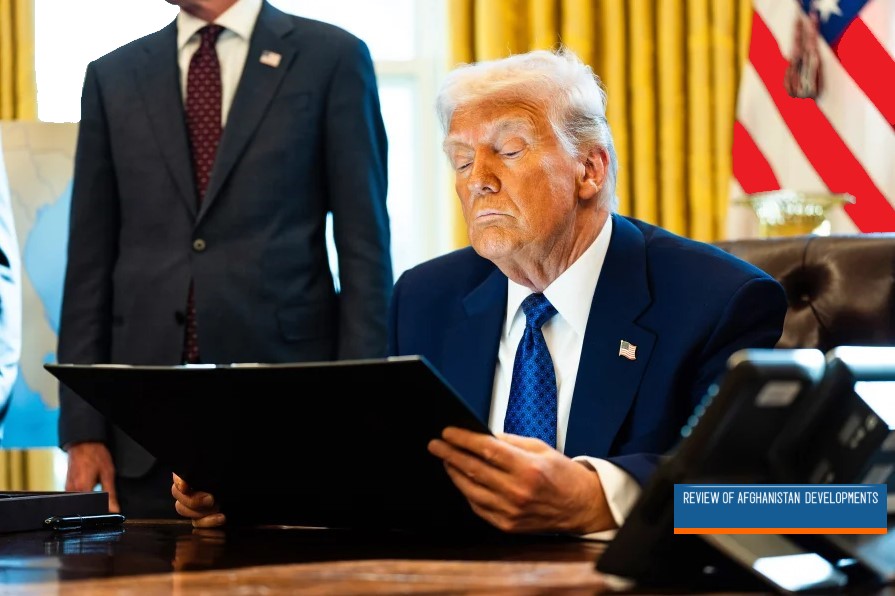
Discussions during the administration of Donald Trump regarding the possibility of regaining access to Bagram Air Base highlighted the continuing strategic value attributed to infrastructure in Afghanistan. Although no permanent re-establishment of US military presence has occurred, the issue underscored Afghanistan’s residual operational significance.
Access to facilities such as Bagram would enhance surveillance and rapid-response capabilities in the broader region. At the same time, political realities and strategic recalibration have thus far limited the pursuit of renewed basing arrangements.
Managing Taliban Relations with China, Russia, and Iran
Another dimension of US policy toward Afghanistan concerns the Taliban’s diplomatic and economic engagement with neighboring and regional powers, including China, Russia, and Iran. While the Taliban’s interactions with these states do not automatically alter their relations with the United States, Washington remains attentive to the possibility that Afghanistan could become a platform for strategic initiatives adverse to US interests.
China’s economic outreach, Russia’s regional security posture, and Iran’s cross-border considerations each shape the Taliban’s external relationships. In response, US engagement with the Taliban can be interpreted as part of a broader effort to ensure that Afghanistan’s external alignments do not undermine American strategic objectives.
Policy Instruments: Sanctions, Assets, and Diplomatic Channels
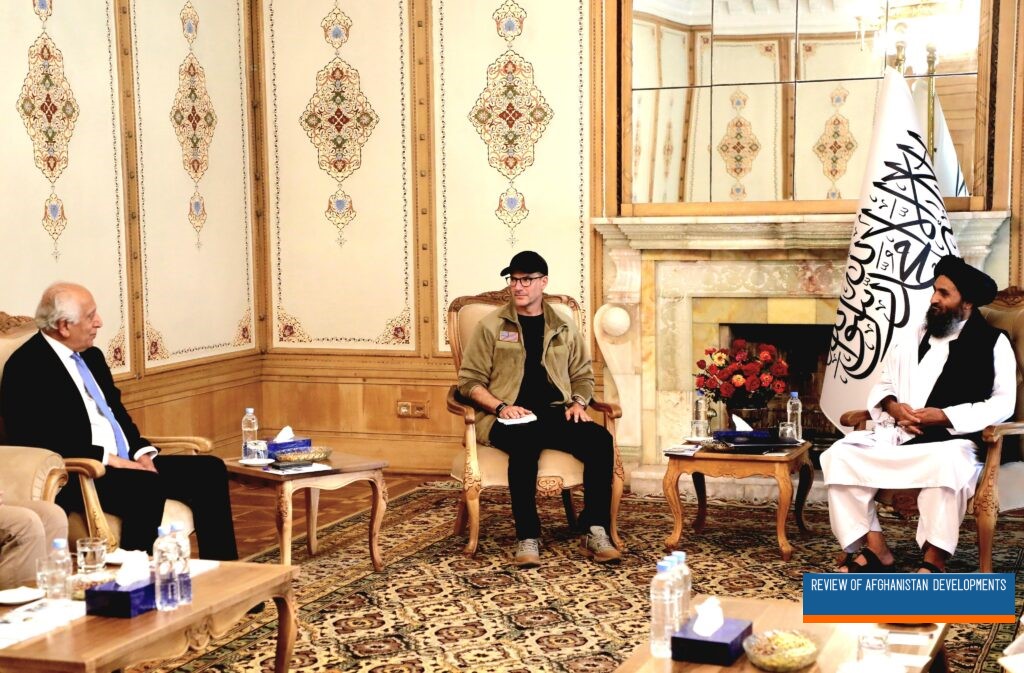
US influence over the Taliban government rests on a defined set of policy instruments. These include continued non-recognition, targeted sanctions, oversight of frozen Afghan financial assets, and diplomatic engagement through bilateral and multilateral channels.
Sanctions are designed to exert pressure while preserving flexibility. However, their application is calibrated to avoid exacerbating humanitarian conditions to a degree that would produce destabilizing consequences. Similarly, decisions regarding access to Afghan central bank assets are structured to balance accountability with stabilization objectives.
Diplomatic engagement, even in the absence of formal recognition, provides channels for communication on counterterrorism, humanitarian coordination, and regional stability. Collectively, these instruments reflect a policy framework oriented toward influence without direct governance responsibility.
Related Articles
Regional consensus against US return to Bagram
Consequences of Trump’s approach to the Taliban
Conclusion
In summary, US policy toward Afghanistan does not signal a return to expansive state-building, nor does it represent complete strategic disengagement. Rather, it is structured around managing risks and containing threats at sustainable political and financial costs.
Domestically, the primary objective remains preventing Afghanistan from serving as a safe haven for terrorist organizations, particularly ISIS-K, through remote monitoring and limited operational engagement. Humanitarian assistance is directed toward preventing systemic collapse without endorsing or reconstructing Taliban governance structures. Human rights concerns remain embedded in diplomatic discourse and policy conditionality.
Externally, Afghanistan is viewed within the broader framework of strategic competition involving China, Russia, and Iran. US policy seeks to prevent adversarial exploitation of Afghanistan’s geography and political orientation while maintaining leverage through sanctions, asset control, and conditional engagement.
Accordingly, the United States’ approach toward Afghanistan can be characterized as a strategy of controlled containment and calibrated interaction—maintaining oversight and influence while minimizing direct commitments.