
Review of Afghanistan developments
Electricity crisis in Afghanistan in persists and has emerged as one of the nation’s most significant structural challenges; a situation that has directly impacted the everyday lives of millions of Afghan citizens, influencing everything from home lighting to the operations of hospitals and industries, making it even unfeasible to supply Kabul with continuous electricity for 24 hours.
The visible effects of the energy crisis in Afghanistan are evident in that merely 40 percent of the population has access to electricity, there are regular power outages in Kabul and four significant cities, there is an inadequate supply of energy for industrial zones, and there exists a substantial reliance on imported electricity.
Electricity crisis in Afghanistan is a result of significant energy disparities created by prior administrations, which the Taliban government is currently confronting. In order to tackle this issue and ensure a reliable electricity supply, the Taliban have implemented a range of plans that include both short-term and long-term strategies. Some of these plans are designed for immediate impact and quick returns, while others require substantial infrastructure development and are more time-consuming.
At present, Afghanistan generates a minimal amount of electricity from domestic sources, approximately 300 megawatts, which constitutes nearly one-seventh of the country’s peak demand. The electricity produced is primarily sourced from hydroelectric power facilities (including the Naghlu and Kajaki dams) and thermal power stations (such as Tarakhel and Sheberghan). However, these power generation facilities, aside from their limited capacity, encounter three significant challenges: water scarcity, elevated fuel costs, and deterioration. Considering Afghanistan’s increasing population and its transition towards industrialization, the electricity demand in the country over the next five years is projected to be at least around 10,000 megawatts.
What measures is the Taliban taking to address the electricity crisis in Afghanistan?
Drawing from strategies established during the republican era, the Taliban administration has initiated a multi-phase approach to address electricity crisis in Afghanistan, incorporating both immediate and long-term solutions.
Quick and effective strategies to address the issue of energy deficiency
The foremost action taken has been to prolong the electricity import agreements with Iran, Turkmenistan, Uzbekistan, and Tajikistan. Settling the debts owed by nations such as Uzbekistan, which have been pending since the republican era, along with the annual renewal of contracts, has guaranteed that the same volume of imported energy remains uninterrupted. The cumulative electricity imported from these nations ranges from 620 to 800 megawatts.
Nevertheless, the volume of electricity imported does not satisfy domestic demand, and this significant reliance renders Afghanistan highly susceptible to political unrest or harsh winter conditions. During periods of peak domestic consumption, Tajikistan and Iran curtail their electricity exports to Afghanistan, resulting in power shortages in Kabul, Herat, and various other cities across Afghanistan during the winter.
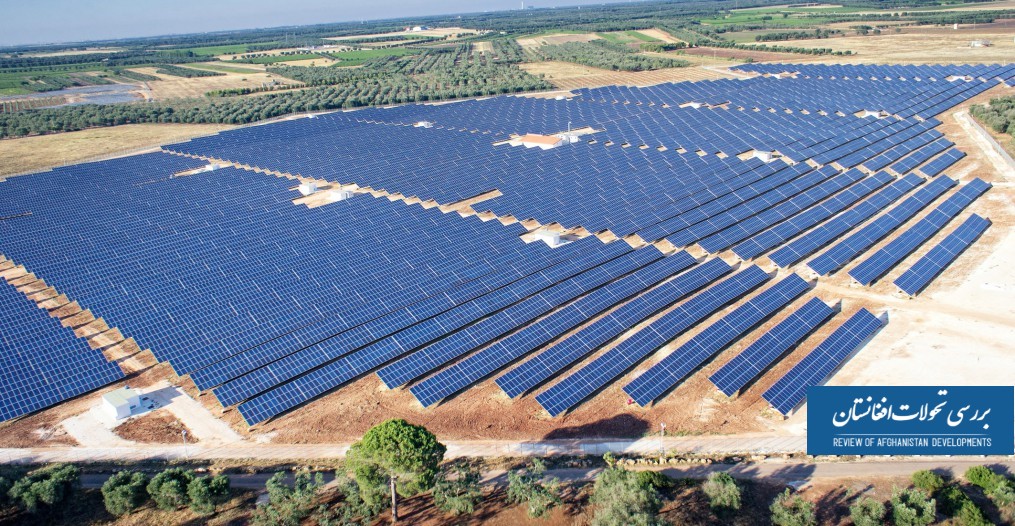
The second initiative of the Taliban government regarding quick-pay projects involves the establishment of solar power plants with low to medium capacity. In the last two years, numerous solar power initiatives have been initiated across various regions of Afghanistan, particularly in underprivileged and at-risk areas, with some already operational. Notable projects include the 20-megawatt power plant in Bamyan, the 22-megawatt power generation project in Surobi, the 5-megawatt solar power facility in Herat, and the 40-megawatt power generation project in Logar.
The third initiative involves increasing electricity imports from Central Asian nations. The Taliban administration has initiated two significant projects aimed at importing electricity from Uzbekistan and Turkmenistan, with one project currently in its final phase. The details of these two electricity import projects from Central Asia are outlined below:
Turkmenistan-Afghanistan 500 kV power transmission line
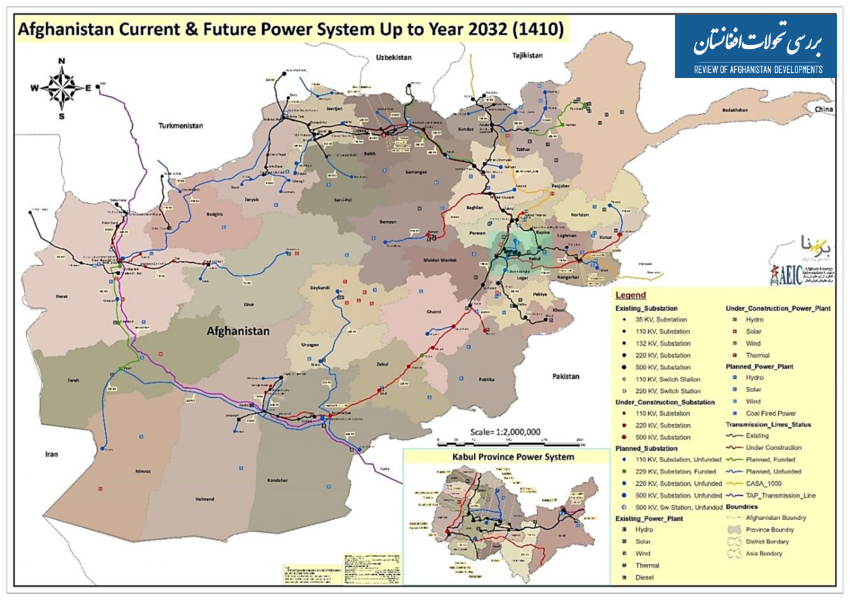
The 500 kV Sheberghan-Dasht-Alwan power transmission line initiative stands as one of the most lucrative infrastructure endeavors within Afghanistan’s electricity sector, significantly contributing to the resolution of the country’s electricity imbalance. This transmission line, boasting a capacity of 1,000 megawatts, is designed to facilitate the import of electricity from Turkmenistan to Afghanistan. In this undertaking, 775 poles and towers will be utilized to convey electricity imported from Turkmenistan through the provinces of Jawzjan, Balkh, and Samangan, ultimately reaching the Dasht-Alwan Station located in Baghlan Province.
Subsequently, this transmission line will be routed to Arghandeh Square in Kabul. It is intended that this transmission line will provide electricity to Kabul, Logar, Maidan Wardak, Ghazni, Kandahar, Nangarhar, and Kunar provinces, as well as the Northern provinces. As per the declarations made by officials from the Breshna Company and the Deputy Minister of Economy, the project is currently 95 percent finished.
This power transmission line, once completed and commissioned, will significantly enhance the electricity landscape in Afghanistan. The significance of this project extends beyond its technical and economic aspects; it also encompasses social, security, and political ramifications. As stated by officials from the Afghan Power Company, the completion of the 500 kV Sheberghan-Dasht Alwan line will ensure a continuous electricity supply to 12 provinces.
Hope for 24-hour & continuous electricity supply in Kabul
One of the significant advantages of the 500 kV Sheberghan-Dasht-Alwan line is its provision of a continuous 24-hour power supply to Kabul, a city that experiences critical power shortages, leaving its residents without electricity for several hours each day. As Afghanistan’s most densely populated city, Kabul has faced ongoing power deficits for many years; frequent blackouts have not only disrupted the daily routines of its citizens but have also hindered the operations of offices, schools, hospitals, and industrial facilities. The implementation of this project has the potential to alleviate the strain on the capital and reduce the reliance on a limited number of power lines that currently traverse Pul-e-Khumri and Salang.
500 kV power transmission line between Uzbekistan and Afghanistan
In August of this year, a pact was established between the governments of Afghanistan and Uzbekistan to construct a 500 kV power transmission line from Uzbekistan to Afghanistan. As per the agreement, this power transmission line is expected to convey between 800 and 1000 megawatts of imported electricity from Uzbekistan to Afghanistan. The power line is planned to link Uzbekistan with the Dasht-e-Alwan area in Baghlan province, which serves as a crucial hub in the Afghan power grid.
Additional clauses of this agreement encompass the establishment of the Arghandeh Chowk substation in Kabul, which will have a capacity of 800 megavolts, the erection of a 220-kilovolt power transmission line connecting Kabul and Nangarhar, as well as the construction of the Sheikh Masri substation located in Nangarhar.
The contract amounts to $242 million, funded by the Uzbek party. The completion of the project is anticipated within 18 months, with expenses to be disbursed in stages by the Afghan Electricity Company (Afghanistan Breshna Company).
The Taliban and electricity crisis in Afghanistan: An Examination of Infrastructure Initiatives
Alongside short-term strategies that primarily depend on low-capacity power generation and electricity imports from Central Asia, long-term initiatives focus on substantial power generation in Afghanistan through the establishment of hydroelectric power plants as well as solar, thermal, and wind power facilities across different regions of Afghanistan. The execution of these projects will predominantly involve private sector investment and is expected to take place over a timeframe of 2 to 10 years. Among the most significant of these initiatives are the following:
Azizi Group to produce 10,000 megawatts of electricity
In August 2025, a memorandum of understanding regarding an investment valued at $10 billion was executed between the Afghan Ministry of Energy and Water and a private entity known as Azizi Group.
As stated in this memorandum, the company will construct power plants utilizing coal, water, wind, and gas sources, totaling a capacity of 10,000 megawatts across various provinces in Afghanistan. The completion and operational launch of these power plants are scheduled for 2032, with an investment of 10 billion dollars. According to the announcement made by both parties involved in the contract, the initial phase of the project will commence with the generation of 3,400 megawatts of electricity from coal sources in different provinces of Afghanistan;
– 750 MW in Mazar-e-Sharif
– 500 MW in Hairatan
– 400 MW in Baghlan
– 400 MW in Bamyan
– 150 MW in Herat
The subsequent phase of the project will encompass hydroelectric, gas, and solar power facilities;
– Gas power facilities with a capacity reaching 3700 MW
– Hydropower facilities up to 2700 MW
– Solar power facilities up to 200 MW
As reported in the news, Azizi Group Company has commenced field studies for the initial phase of the projects, and the Afghan government places significant hope in this initiative to address electricity crisis in Afghanistan and transform the country into an electricity exporter.
Production of two thousand megawatts of electricity by Kam Group Company
In September 2025, the Afghan Electricity Authority, known as Afghanistan Breshna, entered into a contract with a private entity named Kam Group. Under this agreement, Kam Group has pledged to invest in the generation of 2,000 megawatts of electricity within Afghanistan. The anticipated duration for the completion of this project ranges from three to seven years, and it will produce electricity utilizing a variety of sources, such as water, gas, wind, and geothermal energy.
The organization is set to generate electricity in Afghanistan in collaboration with Dutch and Danish partners. Given Afghanistan’s significant potential for harnessing electricity from wind resources, the Kam Group has declared its plan to establish a wind turbine manufacturing facility in the country. The objective is to generate 1,000 megawatts of the anticipated electricity using these wind turbines.
Ghazanfar Group produces 240 megawatts of electricity
In September 2025, the Breshna Company entered into an agreement with the private entity “Ghazanfar Group” to construct power plants with a combined capacity of 240 MW across the provinces of Sheberghan, Balkh, Logar, Kabul, and Herat. In Sheberghan, a thermal (gas) power plant with a capacity of 50 MW will be established at a cost of $70 million over a period of 18 months. In Balkh, a solar power plant with a capacity of 40 MW will be developed with an investment of $31.15 million over 16 months. In Logar province, another solar power plant with a capacity of 40 MW will be constructed with a budget of $36 million over 18 months. In the Shakar Dara area of Kabul, a project with a capacity of 70 MW will be built at a cost of $52 million over 21 months, and in Guzra, Herat, a solar power plant with a capacity of 40 MW will be established with a budget of $36 million.
Reconstruction and completion of Afghanistan’s electricity distribution network
One of the incomplete objectives in Afghanistan’s energy sector is the establishment of a comprehensive electricity distribution network. Without a national electricity grid, addressing Afghanistan energy crisis is unfeasible. In December, Breshna revealed that $820 million has been designated for the enhancement of Afghanistan’s electricity network this year.
The Taliban government’s challenges in resolving the electricity crisis in Afghanistan
Furthermore, addressing electricity crisis in Afghanistan necessitates the surmounting of various obstacles and challenges, in addition to the previously mentioned measures. While the Taliban government has not conditioned the resolution of the electricity crisis on foreign assistance and intends to progress these projects through domestic budgets and the attraction of investments, such a level of investment demands a secure and stable environment. Nevertheless, it is essential to realistically acknowledge that the infusion of tens of billions of dollars into Afghanistan’s electricity sector requires enduring security and political stability.
The Taliban government must take further action to enhance the stability of political and security conditions in Afghanistan. Ensuring the protection of power transmission lines and power plants, which will be distributed across the country, necessitates a substantial security presence. These installations represent an accessible target for militant organizations aiming to undermine the government.
Another obstacle in addressing electricity crisis in Afghanistan is effective project management; past experiences indicate that numerous national projects encounter issues related to bureaucracy, corruption, and conflicts of interest among individuals and institutions both in their early phases and throughout their execution. This issue led to the stagnation of many infrastructure initiatives in Afghanistan during the republican period, such as the Totap project. While bureaucracy and corruption have been significantly reduced under the current administration, it is essential to remain vigilant regarding the potential for conflicts of interest between individuals and institutions.
The third challenge pertains to the technical upkeep of energy projects. Once the power generation projects are finalized, it is essential to have the human capacity to sustain these projects. Given the migration of specialists, Afghanistan must focus on training its human resources to operate power generation facilities. In this context, it is imperative to establish contracts for training human resources with neighboring countries that possess the requisite experience and capabilities in this area.
Related Articles
Feasibility of Increasing Iran-Afghanistan Trade to $10 Billion
The Economy of Afghanistan under Taliban governance
Conclusion
In summary, electricity crisis in Afghanistan primarily caused by inadequate electricity generation within the country, resulting in 60 percent of the Afghan population lacking access to electricity. Additionally, 40 percent of the population does not have reliable, 24-hour electricity, with many cities, including Kabul, suffering from frequent power outages. The Taliban aim to resolve electricity crisis in Afghanistan and energy disparity in the short term by importing 500 kilovolt electricity from Turkmenistan and Uzbekistan, and in the medium term by constructing hydroelectric, thermal, wind, and solar power plants. Both strategies are crucial, as extensive imports are necessary for Afghanistan’s short-term electricity supply, while domestic energy production offers affordable and sustainable electricity.
The current Afghan authorities envision that the nation will emerge as a source of electricity exports in the region in the coming years. Despite the investment pledges in the Afghan electricity sector totaling approximately 30,000 megawatts, significant progress is still required for full realization. Nevertheless, if the Taliban can manage the electricity crisis in Afghanistan and even if avert it from advancing to the export phase, it will have made a substantial advancement.
Electricity serves as the foundation of a nation, and its absence renders the achievement of the Afghanistan National Development Strategy unattainable. Addressing the electricity crisis in Afghanistan will not only provide contentment to its citizens but will also bolster the country’s economic development and elevate its standing in the region. This is particularly true if the electricity is derived from renewable sources such as solar and wind energy. The essential conditions for fulfilling the vision set forth by the Taliban government include establishing a stable political and security environment, followed by effective management of these initiatives.
Follow us on social Media