
Review of Afghanistan developments
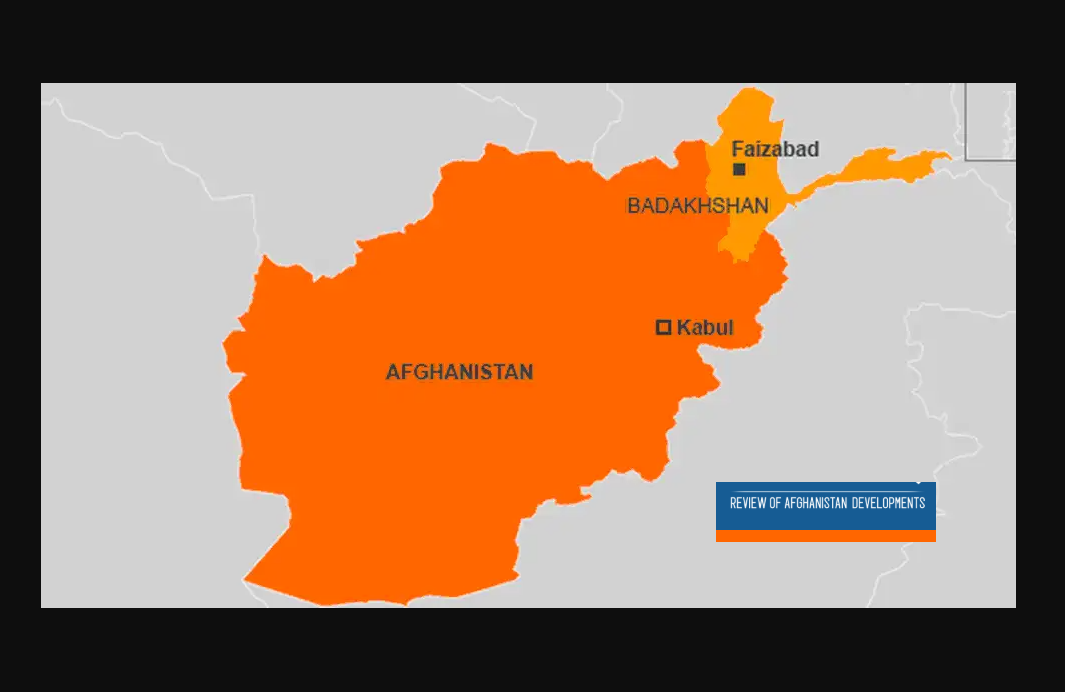
Since the protests in Badakhshan commenced on May 8, 2026, a critical question has resurfaced: Why do certain Afghan farmers persist in cultivating opium poppy, even in defiance of the Taliban government’s extensive prohibition on such cultivation? The explanation for this phenomenon cannot be reduced merely to issues of legality, resistance, or the illicit economy. The current situation in Badakhshan represents a conflict between the initiative to eliminate opium poppy fields and the precarious state of Afghanistan’s rural economy, which has increasingly relied on the income derived from opium poppy cultivation over the last twenty years.
The recent protests, which resulted in the deaths of at least two individuals, were not merely a response to the destruction of opium farms; rather, they signify a more profound crisis within the livelihood framework of rural Afghanistan. In numerous impoverished regions, poppy cultivation transcends being just an agricultural commodity; it forms an integral part of the survival mechanism, encompassing credit, debt repayment, and local financial circulation. Consequently, the abrupt loss of this income source, without the establishment of an economic alternative, plunges many rural families into a cycle of poverty and instability. Badakhshan has now emerged as a focal point where three crises are concurrently converging: a crisis of the rural economy, a crisis of political legitimacy, and a crisis of drug management.
Badakhshan protests: From security issues to political economy crisis
Following the Taliban’s resurgence to power, they announced a prohibition on drug cultivation as a key component of their policy agenda. This policy was enforced more rigorously in several southern provinces of Afghanistan, particularly in Helmand and Kandahar, where a considerable number of farmers decreased their poppy cultivation due to security pressures, fear of repercussions, or compliance with the directives of the Taliban leadership. Conversely, the scenario in Badakhshan was distinct. In this province, certain farmers not only persisted in cultivating poppy but, in some instances, actively opposed the eradication of their fields.
Analyzing this situation is not feasible without a comprehension of the social and economic framework of Badakhshan. Badakhshan ranks among the most underprivileged provinces in Afghanistan; it is a mountainous area characterized by inadequate infrastructure, restricted market access, limited employment opportunities, and a significant reliance on the informal economy. Under these conditions, poppy cultivation has emerged as a crop that can sustain the basic living expenses of villagers in recent years. Consequently, some of the recent protests ought to be interpreted not merely as resistance to the law, but rather as a response to a threat against their livelihoods.
In the literature of political economy, the informal economy’s significant role in a society’s survival means that its abrupt removal can result in social instability and political strife. Evidence from numerous countries indicates that policies focused solely on repression, when executed without a comprehensive economic development strategy, frequently provoke social resistance and foster distrust between the government and the populace. The protests in Badakhshan exemplify this disconnect between official policy and the actual living conditions of the society.
Changing poppy cultivation patterns in Afghanistan; Badakhshan a drug hub
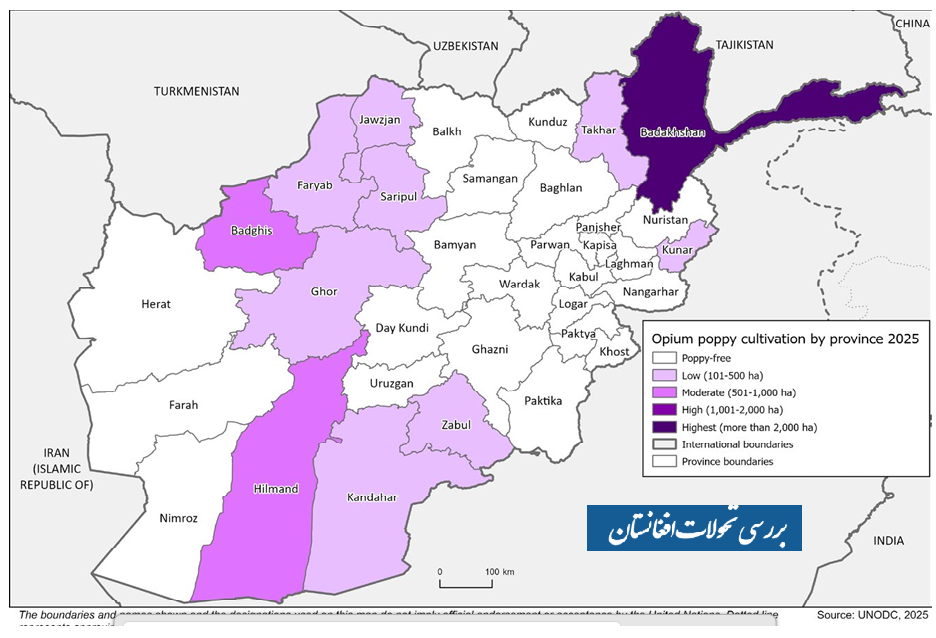
One of the significant advancements in recent years is the shift in the geography of poppy cultivation in Afghanistan. As per the data for the 2025 crop year, the total area dedicated to poppy cultivation in Afghanistan has reached approximately 10,200 hectares, reflecting a decrease of around 20 percent in comparison to the previous year. However, beneath this overall reduction lies a crucial geographical transformation: the relocation of the primary hub of poppy cultivation from southern Afghanistan to northeastern Afghanistan.
According to information from the United Nations Office on Drugs and Crime, Helmand and Kandahar, which have been the primary centers for opium production in Afghanistan for the last twenty years, have now diminished in their significance, while Badakhshan has emerged as a key area for poppy cultivation. This shift can be attributed to several factors. Firstly, the more rigorous enforcement of the cultivation ban in the southern provinces; secondly, the geographical characteristics of Badakhshan that complicate monitoring and control; thirdly, the province’s position along the northern drug trafficking route; and fourthly, the Tajik origin of the province’s inhabitants and the influence of Taliban opposition in the region.
In recent years, the Northern Corridor has emerged as a crucial pathway for the transportation of Afghan narcotics to Central Asia and subsequently to international markets. Consequently, the drug economy in Badakhshan has expanded beyond mere agricultural activities, becoming intertwined with transportation networks, informal commerce, and local financial dynamics. Under these conditions, the eradication of poppy cultivation signifies not just the removal of an agricultural commodity, but also threatens to destabilize a segment of the local economic framework.
On the other hand, the reduction in cultivation within the southern provinces does not unequivocally indicate the total effectiveness of the Taliban’s counter narcotics strategy, as certain production has relocated to regions with less oversight. This illustrates that the drug economy in Afghanistan is robust and adapts its geographical distribution in reaction to security challenges.
Research conducted by the United Nations Office on Drugs and Crime indicates that during the previous crop year, Badakhshan has emerged as a center for poppy cultivation, a situation that is connected to the protests occurring in Badakhshan.
Afghanistan’s rural economy: Why is poppy still more profitable?
One of the primary reasons for the ongoing cultivation of opium poppy in Afghanistan is its significant profitability in comparison to legal crops. Economic data from 2025 indicates that despite a decrease in production and a drop in opium prices, opium poppy continues to yield several times more revenue than legal crops.
In the Helmand province, during the previous year, each hectare of poppy generated approximately $17,000. In contrast, in Badakhshan, each hectare of poppy yielded around $12,000. This highlights a significant disparity between the earnings from poppy cultivation and those from legal crops. For Afghan farmers, wheat produced only about $800, while cotton brought in nearly $1,600 per hectare.
This economic disparity elucidates the reason many Afghan farmers continue to rely on poppy cultivation. As living costs increase, job prospects are scarce, and access to formal markets remains challenging, the decision to cultivate poppy for numerous farmers is primarily an economic choice rather than one based on ideology or politics.
Poppy possesses benefits that legal crops do not offer. It demands less water, boasts a longer shelf life, is more convenient to transport, and has a nearly assured market. Conversely, farmers of wheat or cotton frequently encounter challenges such as insufficient markets, elevated transportation expenses, and price fluctuations. For this reason, even if the Taliban government succeeds in eliminating some poppy fields, the motivation to revert to poppy farming will persist as long as this economic disparity exists.
In the realm of development literature, this scenario is viewed as a case illustrating the inability of the formal economy to rival the informal economy. When illicit activities yield significantly higher profits than those of the legitimate economy, policies based solely on prohibition are insufficient to alter the conduct of producers.
Taliban’s counter-narcotics policy: sudden elimination or economic transition?
The Taliban administration is currently confronted with a multifaceted dilemma. On one side, Taliban seeks to present itself as a governing body that has successfully diminished drug production, a matter crucial for gaining international legitimacy and alleviating political pressure. On the other hand, the rigorous enforcement of this policy may result in a worsening of the economic crisis in rural regions and heightened social unrest.
The situation in Afghanistan, along with that of numerous other nations, demonstrates that a solely security-focused approach to combating drugs, without establishing an economic alternative, typically fails to yield enduring results. In numerous instances, the drug economy merely alters its form and location, while trafficking networks evolve to become more advanced. For this reason, many development specialists assert that the counternarcotic strategy of the Taliban government must shift from immediate eradication to economic transformation in order to achieve success.
Economic transition entails guaranteeing that farmers can achieve a basic level of livelihood security from legal crops prior to discontinuing the cultivation of opium poppy. This necessitates investment in rural infrastructure, the development of irrigation systems, the construction of roads, the assurance of purchasing legal products, the establishment of local markets, and the creation of a credit system.
At present, numerous Afghan villages lack both access to substantial markets and the capacity to engage in the formal economy. In this context, the pressure of security without accompanying economic reform is likely to exacerbate poverty and dissatisfaction. The protests in Badakhshan exemplify this predicament, as a portion of the population perceives that official policies are being enforced upon them without taking into account the economic realities.
Ultimately, the crisis surrounding Afghan opium poppy cannot be regarded solely as an ethnic or security concern. It embodies a legacy of historical underdevelopment, inadequate management of the rural economy, and systemic inequality between the central regions and the periphery. Unless the formal economy is able to offer a genuine alternative to income derived from poppy cultivation, the probability of ongoing protests, the perpetuation of the informal economy, and the geographical relocation of opium farming will persist.
in contrast, tackling the poppy crisis in Badakhshan necessitates a comprehensive and coordinated international response. International organizations and donor nations can significantly contribute to diminishing the population’s reliance on poppy cultivation, especially by promoting alternative crops that are appropriate for Badakhshan’s mountainous environment, facilitating legitimate value chains, generating local job opportunities, and enhancing rural economic infrastructure. Furthermore, offering focused livelihood support during the transition phase can alleviate the financial strain on farmers and diminish the motivation to revert to illegal cultivation.
Related Articles
Situation of Jamaat Ansarullah in Afghanistan
Murder of Chinese citizens; security enigma for Afghanistan
The role of the mafia in reproducing the Badakhshan protests
In examining the ongoing cultivation of poppies in Badakhshan, it is essential to consider the influence of informal and mafia-style drug networks. In numerous production regions, the poppy economy does not merely represent a straightforward interaction between farmers and the market; instead, it exists within a complicated web of intermediaries, local brokers, smuggling operations, and transnational networks. This structural arrangement enables key participants in the trade to facilitate the persistence of cultivation and, in certain instances, even motivate farmers to maintain poppy cultivation by offering financial incentives or assurances of guaranteed purchases. In this environment, local tensions and protests may also escalate amid competition among local authorities, informal networks, and governmental policies, where the illegal economy, characterized by entrenched interests, resists transformation.