
Review of Afghanistan developments
Five years after the Taliban’s return to power, one of the most significant shifts in Afghanistan has been how Kabul engages with the world. Aaron Zelin, a senior fellow at the Washington Institute, set out to measure this shift in a new study using data on Taliban diplomatic engagements. That’s a valuable addition, because Taliban foreign policy has mostly been visible through headlines about official visits, diplomatic trips, and political statements — not hard numbers.
This piece draws on that research and points to a key finding: over the past five years, Taliban foreign policy has moved past the search for new partners and into a phase of consolidation, then institutionalization. The Taliban government has also gravitated toward a specific set of regional countries and non-Western powers.
Taliban Foreign Policy by the Numbers
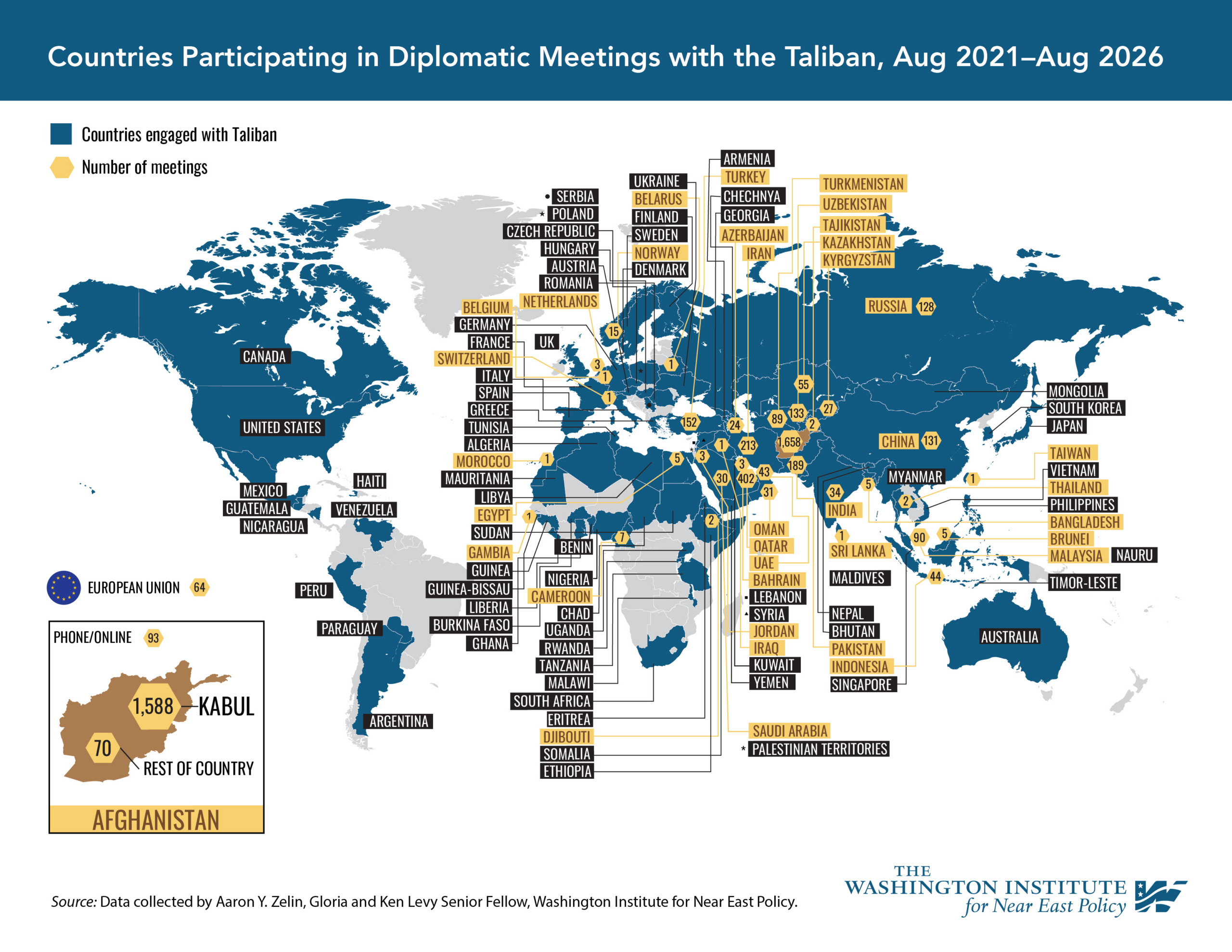
According to Washington Institute data, between August 15, 2021 and August 15, 2026, the Taliban publicly announced 3,651 diplomatic engagements with 103 countries and institutions. Engagements rose from 387 in year one to a peak of 952 in year three, before falling to 844 in year five. So despite a roughly 12% drop from the peak, Taliban diplomatic activity remains high.
These totals are notable on their own, but the real value is in the trend behind them. The number of countries engaging with the Taliban for the first time fell sharply — from 35 in year one and 37 in year two, to just 8 in year four and 3 in year five. Engagement with existing partners, by contrast, has stayed high.
That gap is the key to understanding Taliban foreign policy over the past five years: Kabul is no longer expanding its diplomatic network at the old pace. It’s now mostly working within the network it already built.
Zelin’s research mainly answers which countries the Taliban has engaged with, and how often. But the data also points to a bigger pattern — a three-phase arc in Taliban foreign policy: rapid network expansion after the takeover, consolidation and focus, and finally deepening and institutionalizing the relationships already built.
Phase One: Rapid Network Expansion
In the first two years, the Taliban’s natural priority was building contact with as many countries as possible. The new Afghanistan was a fresh reality for most governments, and the Taliban needed to show it could engage with neighbors, regional powers, and even Western countries.
The 35 new partners in year one and 37 in year two show this phase was largely exploratory. Kabul was testing different channels, while other governments tried to figure out how the new Afghan government would actually behave.
Volume mattered during this period, since the Taliban’s main challenge was breaking its initial isolation and gaining access. But this phase had a limit: not every contact turned into a lasting or institutional relationship.
The data shows this expansion phase eventually hit its ceiling. The sharp drop in new partners suggests the Taliban has identified most of the countries realistically open to engagement.
This matters for understanding Taliban foreign policy. Looking only at the raw number of meetings might suggest Taliban foreign relations are still expanding. But looking at new partners shows network growth has essentially stalled — and the real story has shifted to the quality and depth of existing relationships.
Phase Two: Consolidation and Focus
The drop in new partners — from 37 in year two to 8 in year four and just 3 in year five — is one of the report’s most important data points. It suggests Taliban foreign policy has shifted toward concentrating on a smaller set of countries.
Five countries stand out in particular:
● Iran leads with 494 engagements
● China follows with 432
● Turkey with 394
● Qatar with 347
● Uzbekistan with 316
Together, these five countries account for roughly 54% of all recorded Taliban government engagements. This concentration points to a Taliban foreign policy built around a narrower but deeper network of regional partners.
The makeup of the top partners is also worth noting. Iran has overtaken China as Kabul’s most frequent diplomatic partner; Turkey, Qatar, and Uzbekistan remain among the top partners; and India has moved from limited early engagement to one of the more significant players. Pakistan, by contrast, has taken a very different path — shifting from a key partner to a country in open confrontation with Kabul.
At the same time, the Western share of Taliban engagements dropped from about 16% in year one to just 5% in year five. EU engagement fell from a peak of 20 interactions to 7. That could simply reflect declining Western engagement — or it could be read as part of the broader regionalization of Taliban foreign policy.
A shift in where meetings happen reinforces this pattern. Kabul’s share as a meeting location fell from about 55% in year one to 32% in year five. Increasingly, Taliban foreign policy is playing out in regional capitals and hubs rather than in Kabul itself.
Phase Three: Deepening and Institutionalizing Taliban Diplomacy
In this phase, the most important shift is in the nature of the meetings themselves. The Washington Institute report finds that the share of Taliban statements referencing consular relations and activity rose from 2% in year one to 14% in year five. Year five also saw the Taliban invoke standing mechanisms like the Afghanistan-Kyrgyzstan working group, the Afghanistan-Kazakhstan inter-ministerial commission, and the Afghanistan-Uzbekistan joint trade council. This shift matters: a political meeting can be a one-off event, but a consulate, a joint commission, or a trade council builds lasting infrastructure for a relationship.
That’s why the number of meetings may not be the most useful measure of Taliban foreign policy success. A better indicator is how many of these relationships have turned into permanent mechanisms. The recent boom in joint commissions and chambers of commerce over the past two years suggests the Taliban has moved from simply making contact to building durable channels.
Related Articles
Taliban Performance After Five Years
The Future of Afghanistan Under Taliban Rule: Three Scenarios
Why did the republic in Afghanistan fall? 5 decisive crisis
Conclusion
Over the past five years, the Taliban has failed to secure international recognition. Even so, governments across the Gulf, Turkey, and Central Asia have accepted Taliban-appointed diplomats, and economic and security ties have expanded.
The more important takeaway, then, isn’t the raw number of engagements — it’s that Taliban foreign policy has drawn closer to a specific set of regional countries and non-Western powers, and institutionalized those relationships.
This distinction matters a great deal for Afghanistan’s future. If the current trend continues, Afghanistan could gradually integrate into the region’s economic, security, and transit networks without ever fully entering the diplomatic order the West has in mind.
In that scenario, the central question is no longer “which country will recognize the Taliban?” What matters instead is which countries are willing to build relationships with the Taliban government that function, in practice, like normal interstate relations — without formal recognition.
Perhaps the most important takeaway from this statistical look at five years of Taliban foreign policy is that formal isolation doesn’t necessarily mean isolation in practice. Despite serious constraints, the Taliban government has carved out space for itself between the absence of recognition and rising regional engagement.