
Review of Afghanistan developments
The Taliban-Uzbekistan relations over the last five years has exhibited one of the most varied patterns of interaction between the Afghan caretaker government and its neighboring countries. Although many analysts anticipated that security concerns and political disagreements would dominate the relations between the two parties following the Taliban’s return to power, the unfolding events reveal a different trajectory. From the year 2021 until the conclusion of the second four months of 2026, official engagements between Kabul and Tashkent have progressively evolved from initial political dialogues to encompass economic, transit, and infrastructure collaboration. Key areas of negotiation have included trade, energy, the Trans-Afghan Railway, and the linkage of Central Asia with South Asia; even a contentious issue like the Qosh Tepe Canal has failed to hinder this advancement. By analyzing the five-year trend in relations, this note seeks to illustrate why geoeconomics has emerged as the primary catalyst for Taliban-Uzbekistan relations and the potential implications this trend holds for the future of the region.
Taliban-Uzbekistan relations: from initial contacts to economic partnership
The evolution of Kabul-Tashkent relations after 2021 can be summarized in five stages.
The year 2022 can be viewed as a time of enhanced interaction. The presence of senior delegations, the Tashkent meeting focused on Afghanistan, and conversations about joint initiatives demonstrated that the two parties had progressed past the crisis management stage. At this stage, the Trans-Afghan Railway, electricity exports, and trade facilitation became the central themes of the negotiations.
In 2023, the relationship entered a more stable phase. While there was a slight increase in the number of political visits, the focus of the meetings shifted more towards economic projects and regional connectivity. Technical cooperation and border collaboration persisted during this time; however, contrary to numerous forecasts, security did not emerge as the primary focus of the relations.
The year 2024 marked a significant shift in the Taliban-Uzbekistan relations. The Uzbek Prime Minister’s visit to Kabul, the organization of trade fairs, the active involvement of economic stakeholders, and the signing of multiple memorandums of understanding indicated that the bilateral relations had transitioned into a “geoeconomic” phase. From this juncture, economic matters evolved from mere discussion points to the foundational element of their relationship.
This process was further solidified in 2025. Economic discussions, updates on infrastructure initiatives, agreements regarding preferential trade, investment, and the advancement of transport corridors indicated that both parties were concentrating on executing prior agreements instead of establishing new projects.
This process can be summarized as follows:
2021: Formation of relations
2022: Increased interactions
2023: Consolidation of cooperation
2024: Geoeconomic leap
2025 and 2026: Implementation of agreements and deepening of cooperation
The growth pattern is particularly significant. Economic interactions have seen the most substantial increase; political interactions have followed a mild yet consistent trend; and while security cooperation has consistently been a topic of discussion, it has never emerged as the primary focus of relations.
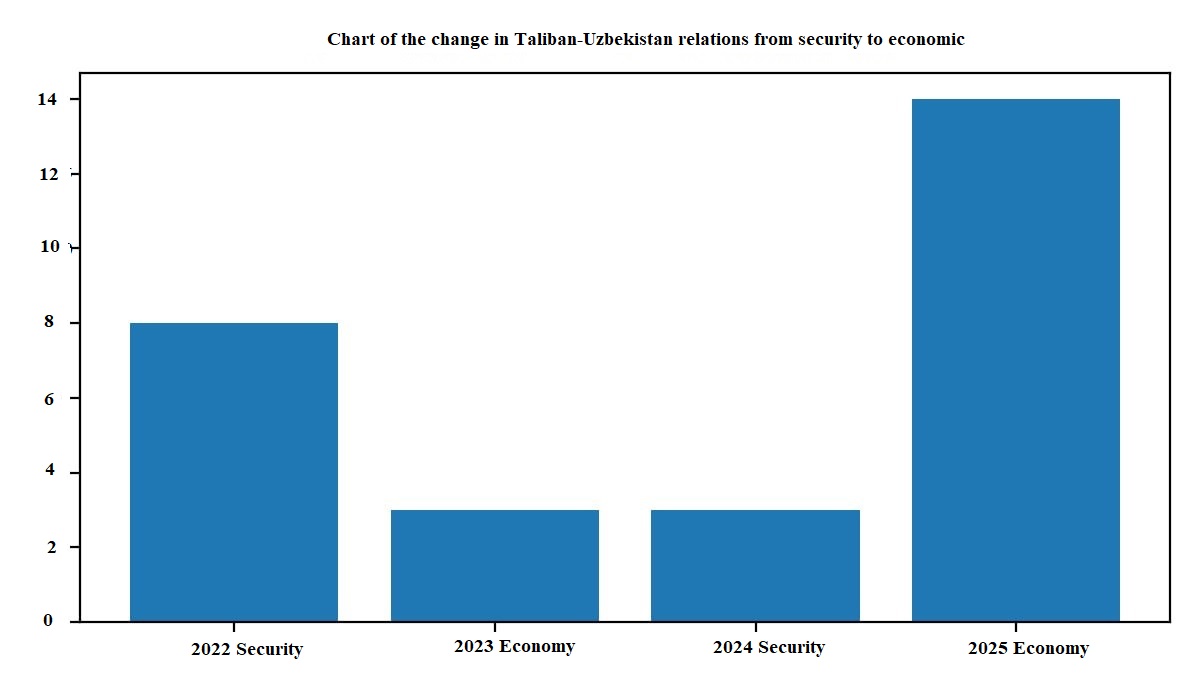
A review of the official interaction data pertaining to Taliban-Uzbekistan relations between 2021 and 2025 demonstrates a marked change in the nature of these interactions, with a noticeable pivot from a focus on security to one centered on economic matters.
Geoeconomics is the main axis of cooperation between Afghanistan and Uzbekistan
One of the inquiries posed by specialists is why the Taliban-Uzbekistan relations has predominantly been influenced by economic factors and regional connectivity, in contrast to numerous other regional relations in Afghanistan. To address this question, one must consider the Taliban’s strategic considerations, Uzbekistan’s approach, and the geopolitical changes occurring in the region.
From the viewpoint of the Taliban, Uzbekistan is more than merely a northern neighbor; it represents one of the limited pathways linking Afghanistan to Central Asia and Eurasia. The Taliban administration, constrained by a lack of international recognition, financial sanctions, and diminished foreign investment, has sought to bolster its practical legitimacy by fostering trade, attracting investment, and executing infrastructure initiatives. In this regard, Uzbekistan has emerged as an appropriate partner, as it has not framed its collaboration with Afghanistan exclusively in terms of security, but has instead highlighted economic projects.
In contrast, Uzbekistan has distinct motivations for this policy. Following Shavkat Mirziyoyev’s ascent to power, Tashkent’s foreign policy has focused on enhancing regional cooperation and establishing the country as a conduit between Central Asia and the markets of South Asia. Realizing this objective is nearly unattainable without Afghanistan. Consequently, the Trans-Afghan Railway initiative, the enhancement of the Termez dry port, the escalation of electricity exports, and the establishment of transport corridors have become integral components of Uzbekistan’s approach towards Afghanistan.
To put it differently, the Taliban requires Uzbekistan to avoid economic isolation, while Uzbekistan relies on the relative stability of Afghanistan to implement its regional connectivity strategy. This interdependence has propelled the relationship between the two parties towards collaboration.
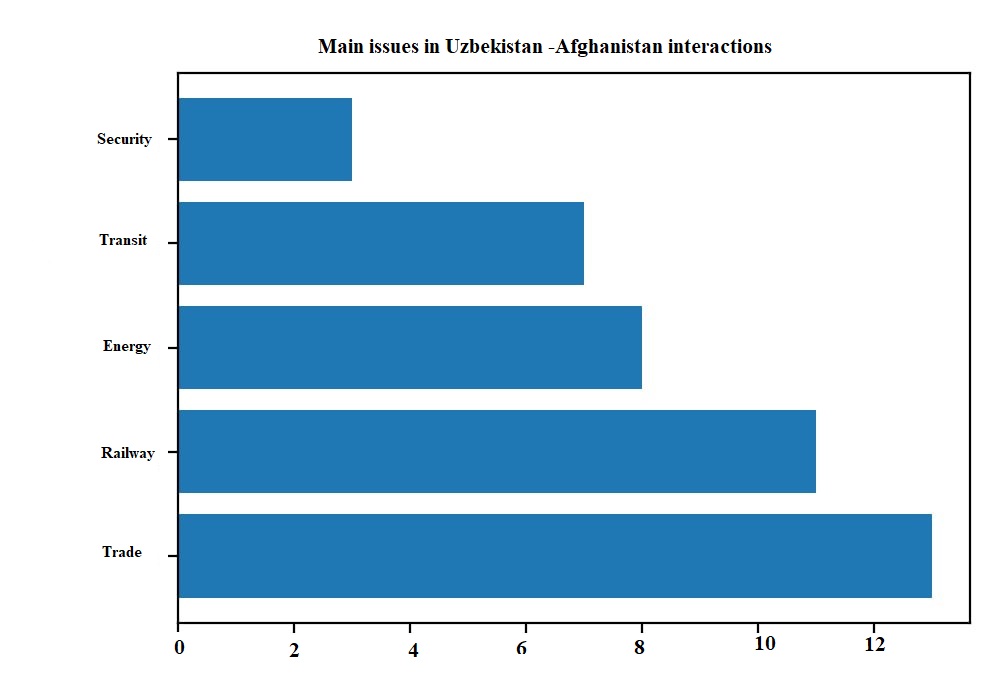
An analysis of the data regarding official communications between Kabul and Tashkent reveals that among the five primary subjects addressed in the meetings, trade emerged as the most frequently discussed topic, while security was the least addressed. This suggests that the Taliban-Uzbekistan relations is increasingly focused on economic matters.
The Taliban-Uzbekistan relations in the context of regional and international dynamics
The development of Taliban-Uzbekistan relations cannot be examined merely as a bilateral issue. These relations are situated within a larger context of competition for trade, energy, and transportation routes. Following the conflict in Ukraine and the rising unpredictability of conventional transit paths, the significance of alternative corridors has escalated dramatically. In recent years, Uzbekistan has aimed to lessen its reliance on northern routes while seeking access to markets in Pakistan, ports on the Arabian Sea, and the Indian Ocean via Afghanistan. The Trans-Afghan Railway initiative stands as the most significant representation of this strategy.
At the same time, China expresses its support for the advancement of regional infrastructure and the enhanced connectivity between Central Asia and South Asia. Russia, despite its security apprehensions, has not opposed initiatives that bolster Afghanistan’s economic stability. Moreover, institutions like the Asian Development Bank and various regional organizations were already engaged in studies concerning these corridors prior to the events of 2021. Consequently, the Taliban-Uzbekistan relations is not merely a result of decisions made by the two governments; rather, it has been influenced by a backdrop of regional competition and collaboration, where economic factors hold greater significance than political ones.
Why didn’t the Qosh Tepe Canal crisis Kabul-Tashkent relations?
A significant issue regarding the Taliban-Uzbekistan relations is the Qosh Tepe Canal project. Considering Uzbekistan’s reliance on the Amu Darya for agriculture, it was anticipated that this project would be a major source of tension between the two parties. However, contrary to these expectations, Tashkent not only refrained from engaging in political and security confrontations but also enhanced its economic, trade, and infrastructure collaboration with the Taliban. This strategy indicates that Uzbekistan has chosen to dissociate the water dispute from other cooperative areas, opting instead to leverage economic interdependence to address differences rather than escalating political costs.
This method is also evident in the evaluations conducted by research institutions. The Carnegie Endowment for International Peace highlights that the Central Asian nations lack sufficient leverage to compel the Taliban to alter their water policy. Consequently, fostering cooperative relations and integrating Afghanistan into regional initiatives represents the most pragmatic approach available to them. The analysis further elucidates that the Taliban views the Qush Tepe Canal as an integral aspect of Afghanistan’s sovereign entitlement to utilize the waters of the Amu Darya. Any political or media pressure is expected to reinforce the group’s stance.
The same viewpoint can be observed in Uzbekistan’s policy orientation. A report from the Institute for Advanced International Studies Uzbekistan reveals that Tashkent’s strategy towards Afghanistan is centered on the gradual integration of Afghanistan into regional cooperation and the promotion of dialogue, rather than increasing confrontation. In this vein, the Minister of Water Resources of Uzbekistan has also stated in an interview with the Uzbek media outlet Kun.uz that Afghanistan has the right to utilize the Amu Darya water resources, pointing out that the main Disagreement is not the principle of the project, but the volume of water extraction and the management techniques employed.
Consequently, it can be concluded that Uzbekistan’s policy is founded on a strategic assessment: the more Afghanistan relies economically on trade, transit, energy, and collaborative projects, the higher the likelihood of effectively addressing challenging disputes, such as the water issue. Therefore, instead of focusing solely on securing the Qosh Tepe Canal, Tashkent has sought to navigate the dispute through technical diplomacy and economic collaboration, a strategy that has thus far averted a water dispute from escalating into a significant crisis in the Taliban-Uzbekistan relations.
Lessons for countries in the region
The past five years of Afghanistan and Uzbekistan relations illustrate that Tashkent, in contrast to numerous regional actors, has formulated its policy with a focus on long-term geoeconomic interests. Uzbekistan has sustained channels of communication, launched infrastructure initiatives, and even in contentious matters such as the Qosh Tepe Canal, has prioritized economic leverage and ongoing negotiations over political conflict. This experience imparts a significant lesson for the nations in the region; concerning Afghanistan, strategic advantage is derived from investing in regional connectivity, enhancing border infrastructure, establishing transit corridors, creating common markets, and fostering economic interdependence, rather than relying solely on political positions. Indeed, the stronger the economic relationships, the better the ability to navigate political and security challenges. As the competition to establish Afghanistan’s primary trade route escalates, the maintenance and enhancement of geoeconomic advantages may prove to be as influential as diplomatic strategies, if not more so, in shaping the future roles of regional countries within Afghanistan’s dynamics.
Related Articles
The interests of regional countries in the Trans-Afghan Railway
Qosh Tepe Project through the Lens of Western Think tanks
Conclusion
A study of the Taliban-Uzbekistan relations spanning from 2021 to 2026 reveals a shift from managing crises to fostering geoeconomic collaboration. The regular increase in official visits, the enhanced participation of economic delegations, the persistence of negotiations concerning railways, energy, and trade, and the mutual avoidance of framing their differences in security terms, all point to the conclusion that economic priorities have surpassed political divergences.
Certainly, this trend does not imply the absence of disagreements; matters such as the Qosh Tepe Canal, border security, the menace posed by extremist groups, and the prospects for international recognition of the Taliban government may still influence the relations between the two nations. Nevertheless, the experiences of the past five years indicate that Tashkent has favored the strategy of ‘engagement to manage differences’ rather than ‘confrontation to resolve differences,’ and the Taliban have perceived this approach as a chance to alleviate their economic isolation.
Consequently, barring any unforeseen changes in the Afghan security landscape, it is anticipated that the dynamics of Uzbek-Afghan relations in the forthcoming years will be evaluated not through political metrics but rather through factors such as trade volume, advancements in the Trans-Afghan Railway, levels of investment, electricity exports, and the establishment of transport corridors. In essence, geo-economics should not be viewed as a peripheral concern; instead, it serves as the primary framework guiding the foreign policy of both nations.