

Review of Afghanistan developments
Author: Maryam Rahmati
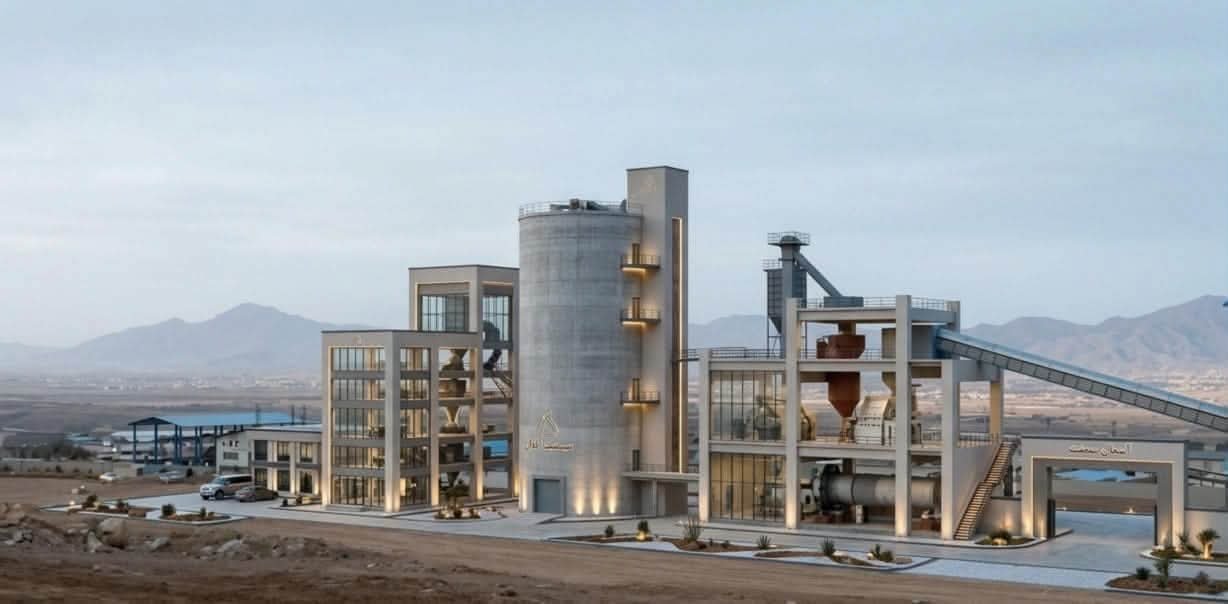
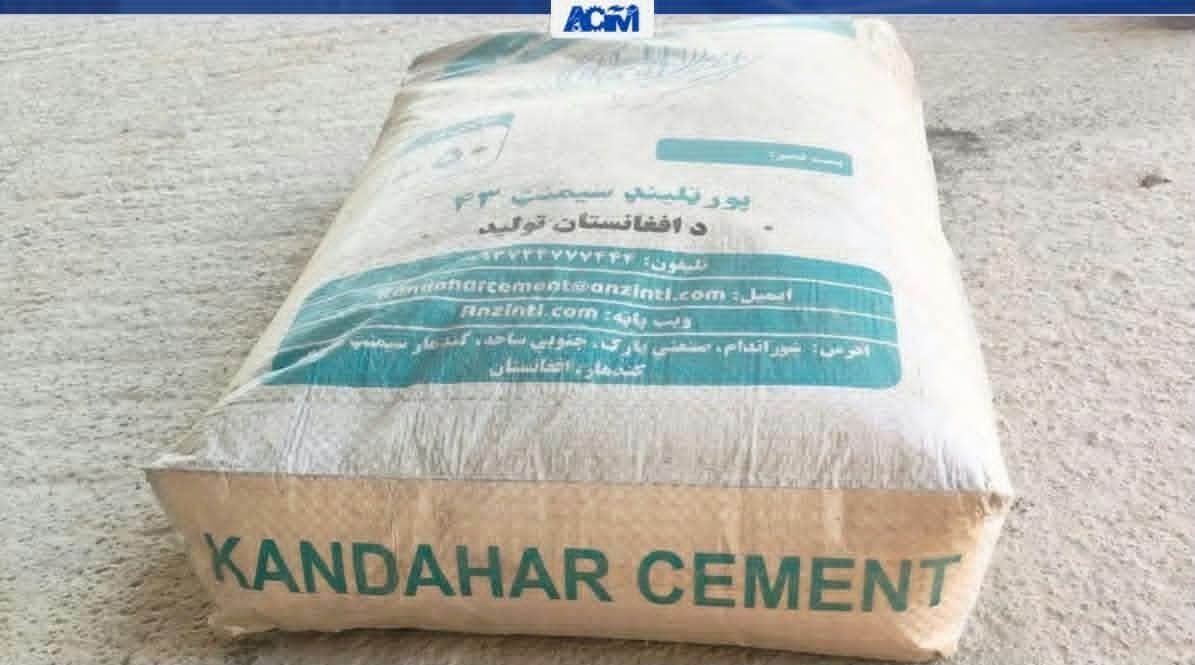
The commissioning of the first phase of the Shorandam Cement Plant in Kandahar has once again placed the development of the Afghanistan cement industry and efforts to boost domestic output at center stage. Constructed with private-sector funding, this facility carries an initial production capacity of 1,500 metric tons per day, projected to scale up to 5,000 tons daily upon completion of subsequent phases.
Benefiting from abundant mineral deposits required for cement clinker and supported by a vast domestic consumer market, Afghanistan holds strong potential to expand its cement sector. Recent years have seen a lineup of capital projects emerge across multiple provinces—initiatives that, upon full delivery and operation, could fundamentally alter the country’s cement supply chain.
In this context, the inauguration of the Shorandam plant forms part of a broader drive to solidify Afghanistan’s manufacturing foundation, curb import dependency, and create viable avenues for investment and employment.
Massive Capital Injections in the Afghanistan Cement Industry
Recent years have seen numerous cement production schemes pitched across several Afghan provinces through private and foreign joint ventures. Given their projected capital size and output metrics, these ventures have the potential to drive a structural shift across the Afghanistan cement industry once completed.
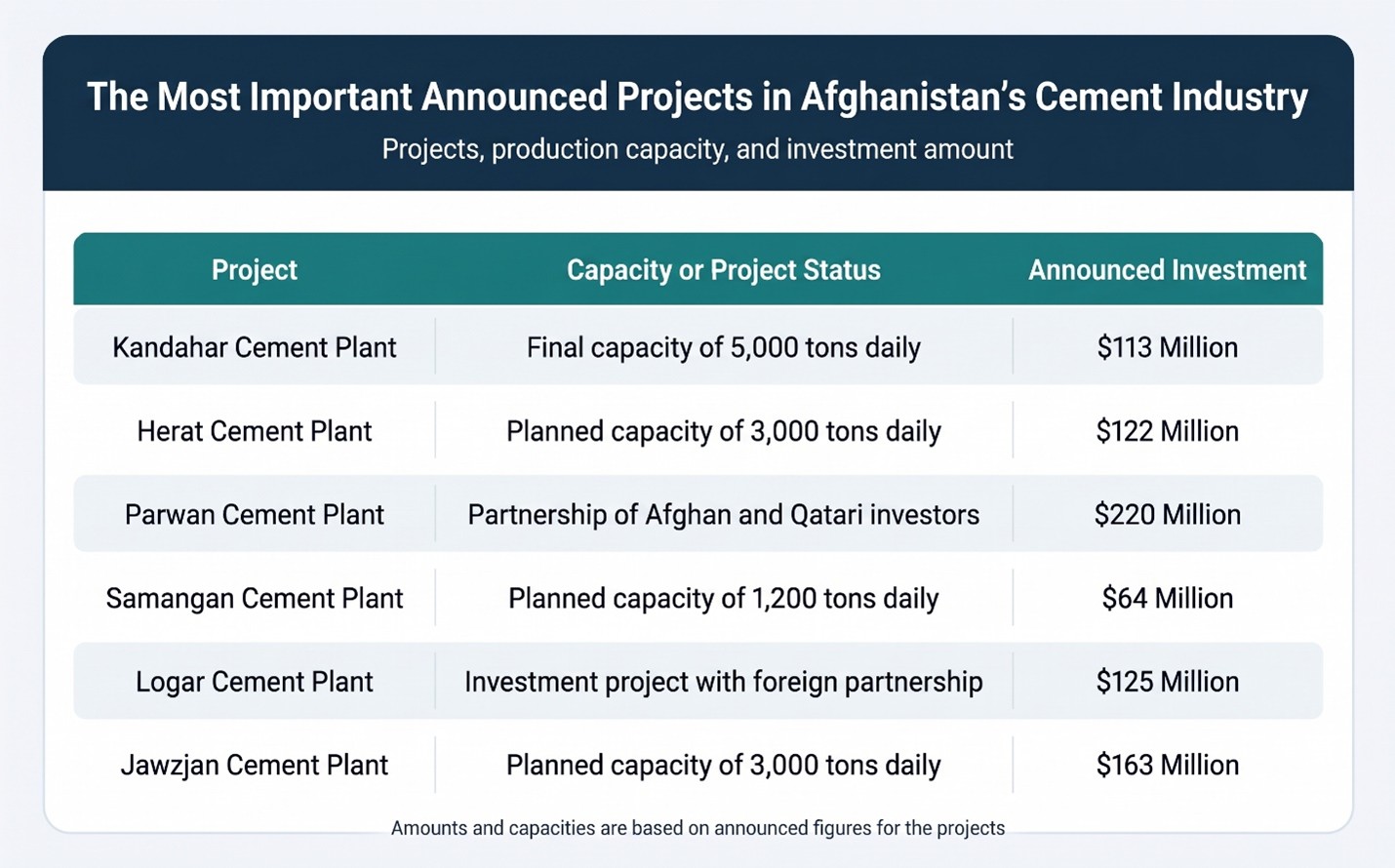
A notable feature across these developments is the collaboration between domestic enterprises and overseas partners. The participation of Afghan, Qatari, Chinese, and Turkish entities across varying concessions illustrates that sector growth is not solely reliant on domestic liquidity, reflecting structured attempts to leverage foreign capital and technical know-how.
These declared investment figures and nominal capacities should not, however, be conflated with realized capital or commercial operations. Several of these ventures remain in early stages, and gauging true progress requires separate evaluations of project financing, civil engineering works, and equipment commissioning.
Why Cement Production Matters for Afghanistan
Driven by extensive post-conflict reconstruction, infrastructure modernizing, and general building activity, Afghanistan represents one of the region’s prominent cement consumption hubs. Highway construction, bridges, residential housing, industrial installations, and civil works depend entirely on an uninterrupted supply of this primary binder.
Estimates released by Afghan economic institutions place the country’s annual cement demand at approximately five to seven million metric tons. Sustained demand of this magnitude, coupled with domestic raw mineral reserves, creates a solid economic rationale for investing in local production.
Expanding the Afghanistan cement industry benefits the domestic economy across several dimensions:
• Lowering Import Dependence: Expanding local supply fulfills domestic market needs while conserving foreign currency reserves and cutting import bills—a critical cushion given that Afghan cross-border trade frequently faces regional political volatility and border closures.
• Job Creation and Economic Stimulus: Beyond industrial line personnel, cement plants mobilize an extensive web of ancillary occupations across quarrying, freight logistics, equipment maintenance, and wholesale distribution, extending economic benefits far beyond plant boundaries.
• Strengthening Civil Construction: Readily available domestic cement—provided it meets competitive pricing and rigorous quality metrics—simplifies materials procurement for commercial real estate and civil infrastructure.
Consequently, capital investments in the cement sector form a strategic component of building durable industrial capacity and diversifying Afghanistan’s economic base—a capacity that, if properly steered, will reinforce interconnected economic sectors.
Afghanistan’s Cement Imports: Moving from Pakistani Reliance to Source Diversification
Historically, Afghanistan sourced a substantial portion of its cement demand via international trade, with Pakistan, Iran, and select Central Asian republics serving as core suppliers. Over recent years, and particularly following political and bilateral trade frictions between Kabul and Islamabad, supplier diversification gained strategic priority. Pakistan has since been displaced from this supply chain, despite previously holding an undisputed monopoly as the top cement exporter to Afghanistan.
Under these market dynamics, expanding domestic production yields both import reduction and increased trade leverage. Simply put, as domestic manufacturers secure higher market share, cross-border disruptions and external export bans exert significantly less pressure on the domestic supply of this staple commodity.
Nevertheless, import substitution remains an incremental process. Unit production costs, technical quality, verified operational capacity, and internal freight rates will ultimately determine how effectively Afghan manufacturers can outcompete foreign product entries.
Can Afghanistan Achieve Self-Sufficiency in Cement?
Against an annual demand of five to seven million tons and a robust pipeline of domestic manufacturing assets, the growth horizon for this sector remains notable.
The Shorandam installation targets an eventual capacity of 5,000 tons per day, while the Jawzjan and Herat facilities are each designed for 3,000 tons daily. Combined, the nominal capacity of just these three complexes approaches four million tons annually.
Should the roughly eight plants currently under construction reach operational completion, Afghanistan could satisfy its domestic requirements while positioning itself to export surplus volumes. Reinforcing this direction, Abdul Ghani Baradar, Deputy Prime Minister for Economic Affairs, affirmed during the Shorandam plant inauguration that the administration intends to transition Afghanistan from a consumption-oriented economy into a producing nation that meets internal demand and exports excess output.
Attaining complete self-sufficiency in cement supply, however, hinges on four structural parameters:
1. Energy Supply: Cement manufacturing demands steady, cost-effective electric power and thermal fuel; inflated power costs directly squeeze margins and elevate final retail pricing.
2. Transport Infrastructure: Moving raw limestone and gypsum to kilns and distributing bagged product across domestic markets requires a resilient road and transit system.
3. Product Quality and Standards: Domestically produced cement must match the structural durability and rigorous quality standards of imported grades to earn commercial confidence.
4. Domestic Stability: Both national and foreign entities only allocate heavy industrial capital where institutional predictability, basic security, and a stable macroeconomic outlook are assured.
Related Articles
Agricultural economy in Afghanistan
Chabahar-Zahedan Railway: Impact on Afghan Transit
Outlook for the Afghanistan Cement Industry
The launch of the Shorandam Cement Plant in Kandahar marks a substantive milestone in Afghanistan’s industrial manufacturing roadmap. Occurring alongside parallel projects across remaining provinces, it confirms that cement production has matured into an attractive focal point for mining and heavy manufacturing capital.
Afghanistan’s chief competitive advantage in this sector lies in the simultaneous availability of raw mineral beds alongside high domestic consumption. If these structural advantages are matched with consistent capital flows, reliable energy grids, and adequate distribution logistics, cement production can emerge as an engine of national economic recovery.
On balance, the Taliban administration has managed to cultivate private-sector participation within the Afghanistan cement industry. The earlier commissioning of a manufacturing line in Parwan province, followed by phase one of the Kandahar facility, represent initial operational steps in a trajectory that aims to carry Afghanistan toward full cement self-sufficiency.
Maryam Rahmati; Economics Scholar and Economic Affairs Analyst.