
By A. Azizi | Security & Political Analyst
Review of Afghanistan developments
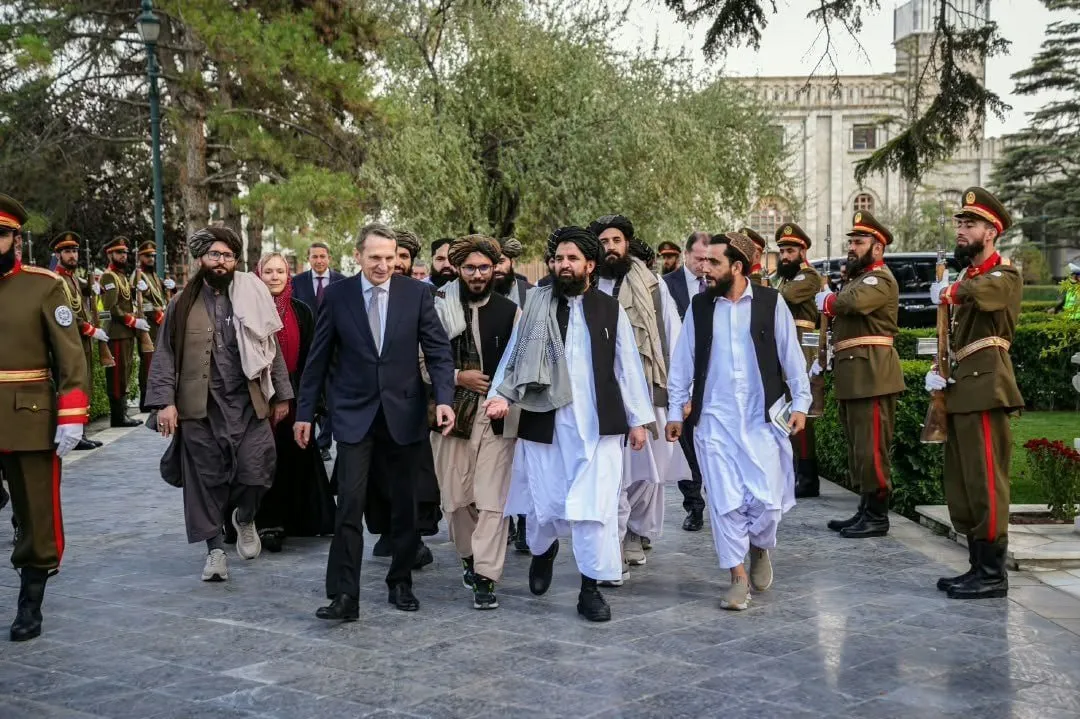
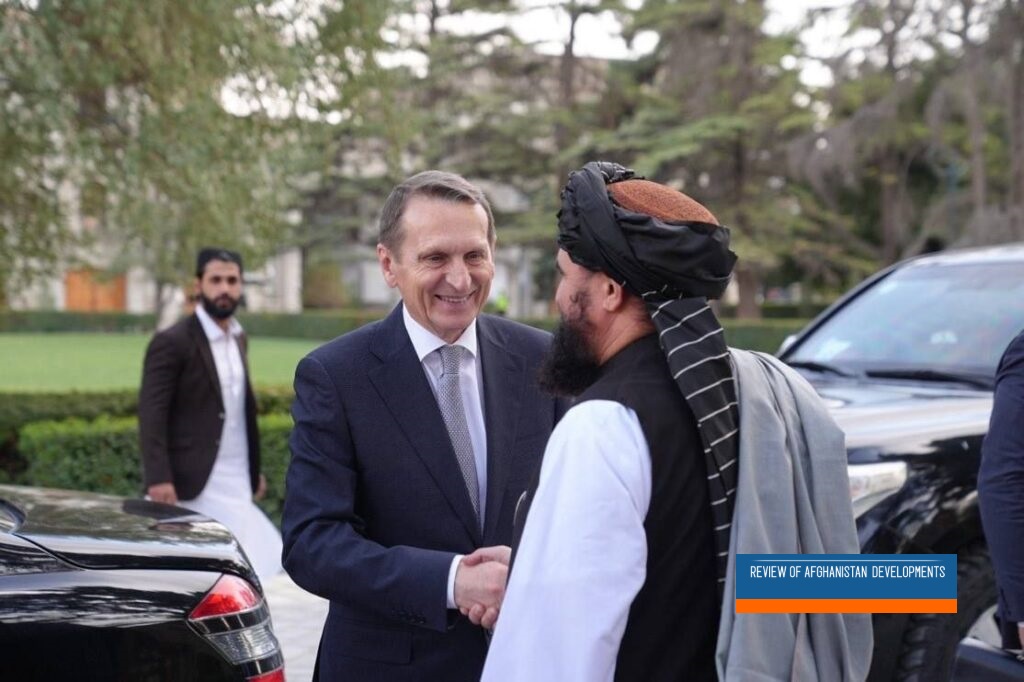
The recent visit to Kabul by Sergey Naryshkin, head of Russia’s Foreign Intelligence Service, signals a major shift: Russia’s ISIS strategy now centers on the Taliban. This trip can be counted among the most important developments in Russia-Afghanistan relations, marking Moscow’s entry into a new phase of engagement with the Taliban government. Naryshkin arrived in Kabul on Wednesday, October 14, and held talks with Mawlawi Abdul Haq Wasiq, head of the Taliban government’s intelligence agency, on “intelligence sharing and joint security cooperation.” What sets this visit apart is Russia’s shift in narrative on the origin of the ISIS threat. Until now, Moscow regarded Afghanistan as the main source of the ISIS-Khorasan threat to Central Asia and to Russia itself. At the eighth Moscow Format meeting, however, a different narrative took shape: ISIS is no longer an “Afghan problem” but a “Pakistani problem.”
Why Russia’s ISIS Strategy Now Centers on the Taliban
Russia’s shift in narrative on the origin of the ISIS threat is clearly visible in the remarks of Foreign Minister Sergey Lavrov. At the eighth Moscow Format meeting in autumn 2026, Lavrov said the Taliban government had been successful in fighting ISIS. But the key point comes a day after the meeting, when Lavrov told a press conference that “the Pakistani branch of ISIS carries out terrorist attacks in both Pakistan and Afghanistan.” That seemingly simple sentence contains a strategic turn. In Russia’s earlier narrative, ISIS-Khorasan was a group based in Afghanistan that threatened Central Asia from Afghan soil; in the new narrative, the root of the threat lies not in Afghanistan but in Pakistan.
A bolder reading holds that Lavrov’s remarks, phrased obliquely for diplomatic reasons, mean that Moscow now defines ISIS as a transnational network centered on Pakistan. Naturally, this change in Russia’s narrative on the origin of the ISIS threat carries significant interpretations and consequences. There are two:
● The Taliban government’s narrative has been accepted by one of the region’s important countries
● Intelligence cooperation with Kabul appears necessary to contain a Pakistan-centered ISIS
ISIS as a Geopolitical Tool in Moscow’s New Narrative
Russia’s shift in narrative on the origin of the ISIS threat shouldn’t be treated merely as an analytical disagreement over the geography of terrorism. This change in narrative serves a specific geopolitical function. At the same Moscow Format meeting, Lavrov urged regional countries to strengthen the Taliban government’s counterterrorism capacity by providing “material, technical, and intelligence assistance” to Kabul. On that basis, the operational logic is that, with Russia’s shift in narrative on the origin of the ISIS threat, Moscow will from now on redefine Kabul as a “frontline bastion” against a transnational threat.
This is what gives Naryshkin’s trip to Kabul its meaning. On this reading, the visit by the head of Russia’s Foreign Intelligence Service was probably aimed at putting Kabul-Moscow intelligence cooperation into operation, on the basis of Russia’s narrative on the origin of the ISIS threat.
It’s also worth noting that in his press conference, Lavrov tied the roots of ISIS to the “illegal US aggression against Iraq.” That means Russia’s shift in narrative on the origin of the ISIS threat is part of a larger whole: the threat of terrorism in the region, in this telling, is a product of Western intervention and could be repeated.
Since the Taliban government’s narrative rests on Pakistan’s instrumental use of ISIS against Afghanistan, Russia may be worried that another intelligence game is on its way. That concern is understandable because Badakhshan, in northeastern Afghanistan and bordering Tajikistan, has been one of the centers of ISIS attacks in recent years.
Operational Consequences for Intelligence Cooperation
Russia’s new view of the ISIS threat has direct operational consequences. In Naryshkin’s meeting with the head of the Taliban government’s intelligence agency, the talks were announced as centering on “intelligence sharing and joint security cooperation.” Within the framework of Russia’s changed narrative on ISIS, this kind of cooperation takes on a particular meaning: if the threat comes from Pakistan, the intelligence Russia needs must also come from Kabul. In this framework, Moscow sees Kabul as a “source of intelligence” and a “front line of confrontation” with a threat it has defined as transnational.
At the Moscow Format meeting, Lavrov explicitly stressed “maintaining contacts through special services and security agencies.” Naryshkin’s trip, as head of Russia’s Foreign Intelligence Service, fits that framework well. Russia’s new view of ISIS also explains why, even as it moves closer to Kabul, Russia has sent its interior minister to Islamabad. Moscow is managing both sides of a tension at once, but Russia’s shift in narrative on the origin of the ISIS threat means that in this management, Kabul’s weight is defined as that of the “party fighting ISIS,” and Islamabad’s as that of the “party on whose soil ISIS is rooted.” This is a strategic choice, not a simple tactical cooperation.
Related Articles
The risk of ISIS Khorasan attacks returning to Afghanistan
Russia-Taliban pact: Afghanistan’s Regional Security Integration
Conclusion
Russia’s new narrative on the source of the ISIS threat should be seen as the most serious development in Moscow’s regional policy since the eighth Moscow Format meeting. Naryshkin’s trip to Kabul, following from this same shift in narrative, shows that Russia is rearranging its security priorities in the south. Moscow no longer sees ISIS merely as an “Afghan problem”; it defines it as a transnational threat of Pakistani origin. This new definition has turned intelligence cooperation with Kabul into an operational necessity.
Russia’s shift in narrative on the origin of the ISIS threat is an analytical tool that lets Moscow, without taking on heavy commitments, draw on Kabul’s intelligence capacity to contain a threat it traces to Pakistan. Naryshkin’s trip is, in effect, the operational execution of that narrative: Kabul as Russia’s “eyes and ears” against a threat that Moscow defines as coming from the east.
A. Azizi is a security and political analyst based in Kabul, Afghanistan. He focuses on analyzing political and security developments in Afghanistan, regional geopolitics, and the evolving dynamics of the region. Due to security concerns, his real identity is withheld to protect his safety