
Review of Afghanistan developments
Although the focal point of ISIS’s operations has transitioned from the Middle East to Africa, ISIS-K continues to pose a significant threat to the region. Indications suggest that ISIS-K, which has been diminished by the Taliban’s recent efforts, is relocating its base to Pakistan’s Khyber Pakhtunkhwa province, potentially signaling a resurgence and ISIS Khorasan attacks in Afghanistan. The increasing tensions along the Afghan-Pakistani border have shifted the Taliban’s attention away from combating this group, thereby creating an opportunity for ISIS-K to re-establish itself.
The geography of ISIS activity has changed: from the Middle East and Afghanistan to Africa
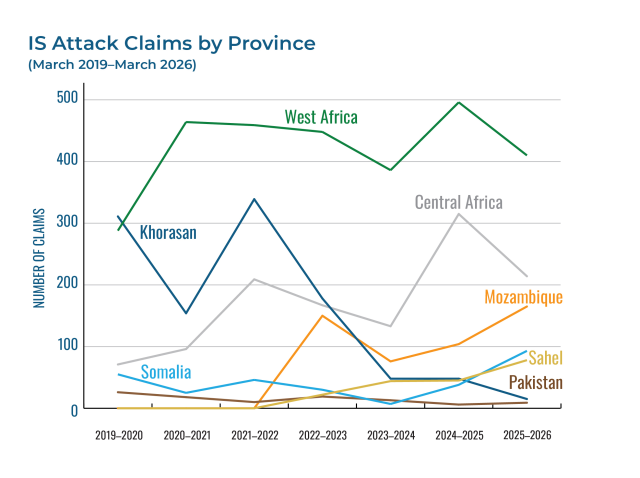
The most notable change in ISIS activity over the last four years has been the relocation of the group’s focal point from the Middle East and Afghanistan to Africa. Following ISIS’s defeat in Iraq and Syria and the loss of 95 percent of its territory between 2017 and 2019, ISIS Khorasan initially experienced significant growth in Afghanistan. This branch, which was formed in 2015 when ISIS supporters in Afghanistan pledged allegiance to the group’s central leadership, has since seen a gradual decline, while branches in West Africa, Central Africa, the Sahel, Mozambique, and Somalia have expanded considerably. Nevertheless, ISIS Khorasan continues to be one of the most active and perilous affiliates of ISIS.
It is essential to recognize that prior to the Taliban’s takeover; Afghanistan was a target of ISIS Khorasan attacks. During the republican era, and in spite of the presence of foreign military forces led by the United States, the group achieved considerable progress through its extensive, bloody, and targeted attacks against Shias and other minority populations, receiving particular attention from the central branch.
Suppression of ISIS Khorasan by the Taliban and migration to Pakistan
One year following the Taliban’s ascension to power, in 2022, there was a significant decrease in ISIS Khorasan attacks, dropping from numerous incidents annually to nearly none. This reduction was attributed to the Taliban’s escalated military actions targeting the group. The Taliban government viewed ISIS-K as a substantial threat to its authority and commenced a thorough and merciless crackdown on its networks.
Due to the stringent policies enforced by the Taliban, ISIS-K relocated primarily to Pakistan as a strategic measure to avoid total destruction. As a result, there was a notable shift in the ISIS Khorasan attacks and assaults. In light of this situation, multiple news outlets have reported the presence of ISIS-K training facilities within Pakistan, and Al-Mirsad, a media organization affiliated with the Taliban regime, has also released documentation supporting this claim.
Terrorist attacks in Iran and Russia, along with attempts to orchestrate operations in Central Asian nations, have demonstrated that ISIS-K is striving to validate its existence through cross-border assaults. Numerous security think-tanks assert that this strategic shift mirrors the approach taken by ISIS following its defeat in Iraq and Syria: diminishing territorial dominance while enhancing its ability to conduct cross-border operations. In February 2025, the US ambassador to the United Nations cautioned that the group posed a global menace and expressed concerns regarding the resurgence and ISIS Khorasan attacks. Consequently, neighboring countries recognized a heightened threat from ISIS-K and prioritized engagement with the Taliban government to counter this emerging danger.
ISIS headquarters relocated near Afghanistan; possibility of increased ISIS Khorasan attacks
ISIS-K has the potential to re-emerge as a significant cross-border threat. The group’s ongoing aspirations to plan and execute operations both within Afghanistan and beyond remain unaltered. At present, the primary factor contributing to the resurgence of ISIS-K is the Taliban government’s preoccupation with tensions involving Pakistan, which is distracting Kabul from addressing the group. In 2025, border tensions at Spin Boldak, Torkham, and other locations along the Durand Line resulted in exchanges of gunfire, temporary closures of border crossings, and interruptions to cross-border trade. Pakistan has consistently accused the Taliban of providing refuge to the Tehreek-e-Taliban Pakistan (TTP).
Despite the Taliban government’s ability to conduct preemptive operations over the past year by arming its forces with suicide drones and executing cross-border assaults on ISIS Khorasan’s bases in Balochistan and Khyber Pakhtunkhwa, indications of new activities by the group have emerged. In the initial years following ISIS Khorasan’s relocation from Afghanistan to Pakistan, the group’s main headquarters were situated in Balochistan province. However, due to the geographical characteristics being unsuitable for ISIS Khorasan, tensions and conflicts emerged between ISIS members and local Baloch groups.
Three reasons for the geographical shift of ISIS headquarters in Pakistan
Following the relocation of ISIS-K to Pakistan, the group became dispersed across various regions, particularly in Balochistan province. However, it has become evident over the past year that there has been a steady rise in the establishment of ISIS-K headquarters in Khyber Pakhtunkhwa province. This growth in their presence suggests that ISIS-K is in the process of restructuring itself to initiate attacks once more in the territory of Afghanistan, specifically from eastern Afghanistan. The movement of ISIS-K headquarters to Khyber Pakhtunkhwa province holds significance for three key reasons:
Initially, the characteristics of this area align with the human identity of ISIS Khorasan. The process of settlement and recruitment in this region is more straightforward and secure for ISIS, whose primary forces are composed of Pashtuns, as the local population is predominantly Pashtun. In contrast, such a uniform demographic does not exist in other regions of Pakistan.
The second factor pertains to the unique geography of the region. The challenging mountainous terrain along the border of the two nations complicates monitoring efforts, thereby aiding ISIS-K’s infiltration into Afghanistan. Furthermore, these hard-to-access areas not only allow ISIS-K to enter Afghanistan but also serve as safe havens and operational bases for their activities.
The third element involves the backing of Salafis located in the eastern provinces of Afghanistan. These elements will enable ISIS Khorasan to take advantage of the distraction faced by Afghan security forces due to the conflict with Pakistan, aided by Salafis who are discontented with the Taliban government. This support will facilitate their infiltration into the eastern provinces and allow for a gradual expansion of their operations into other critical regions, including Kabul.
Recommendations for the region regarding the threat of ISIS Khorasan
In light of the recent activities of ISIS-K and its relocation of headquarters to the Khyber Pakhtunkhwa province, it is crucial to implement a proactive and coordinated strategy to thwart the resurgence of ISIS in Afghanistan. Recent experiences have demonstrated that a solely military and repressive strategy, while effective in the short term, has failed to eliminate the underlying causes of ISIS-K. ISIS-K is re-emerging as a transnational entity capable of executing attacks on a global scale. Consequently, the following recommendations are proposed to address this threat.
Mediation to reduce tensions between Afghanistan and Pakistan
It is essential for neighboring countries to take an active role in mediating and assisting in the resolution of tensions between Afghanistan and Pakistan. The persistent conflict with Pakistan, which is increasingly becoming a chronic issue, is distracting the Taliban government from its efforts to combat ISIS-K. Consequently, this ongoing tension presents a significant opportunity for ISIS-K to take advantage of the security void that has emerged. Regional nations can facilitate direct communication between Kabul and Islamabad by creating a consistent diplomatic framework.
Helping Afghan security forces fight ISIS
It is imperative for neighboring countries to increase their assistance to Afghan security forces in order to counter ISIS-K before it can infiltrate Afghanistan and restore its stronghold. ISIS-K remains intent on executing cross-border attacks. Sergei Shoigu, Secretary of the Russian Security Council, has pointed out that the Afghan leadership is doing everything possible to fight terrorism, yet Western sanctions against the Taliban have impeded this struggle.
The required assistance may encompass sophisticated surveillance and reconnaissance tools, the training of specialized counterterrorism forces, the exchange of current intelligence regarding ISIS-K activities within Pakistan, and financial backing for operations against ISIS. Combating ISIS-K necessitates comprehensive initiatives in education, culture, and economic development, extending beyond mere military actions. In this context, neighboring nations can hinder ISIS-K’s recruitment efforts by investing in counter-extremism initiatives in border regions.
Establishing a regional mechanism to combat terrorism
Considering the transnational aspect of the ISIS-K threat and the group’s secure locations in Pakistan, it is crucial to create a regional counterterrorism framework. This framework could perform functions such as sharing information, coordinating cross-border operations, combating terrorist financing, and monitoring borders.
Monitoring the movements of ISIS Khorasan in Khyber Pakhtunkhwa
In light of the relocation of ISIS-K headquarters to the Khyber Pakhtunkhwa province, it is crucial to closely monitor the group’s activities in the area. Countries in the region should urge Pakistan to eliminate ISIS-K safe havens within its territory and to either hand over or expel its members.
Related Articles
The new role of ISIS Khorasan in the region
ISIS Khorasan’s migration from Afghanistan to Pakistan
Conclusion
In spite of the Taliban’s extensive crackdown, ISIS-K has not only survived but is also gearing up for a comeback in Afghanistan by restructuring its strategy and relocating its headquarters to the Khyber Pakhtunkhwa province of Pakistan. Ongoing border tensions between Afghanistan and Pakistan have shifted the Taliban’s attention away from combating this group, thereby creating an opportunity for ISIS-K to regain strength. The UN report characterizes ISIS-K as a significant threat not only within Afghanistan but also in the surrounding region and beyond, and it raises concerns about the potential transfer of Syrian fighters to Afghanistan, underscoring the group’s resolve to broaden its operational reach.
Countries in the region must take proactive measures to avert a security disaster before ISIS-K can re-establish its foothold in Afghanistan. This can be achieved by mediating to ease tensions between Afghanistan and Pakistan, supporting Afghan security forces, creating a regional counterterrorism framework, and keeping track of the group’s activities in Khyber Pakhtunkhwa. Past experiences indicate that a passive and reactive strategy will merely exacerbate the ISIS-K threat and lead to greater burdens on the region.
One Response
nice note!