
By A. Azizi
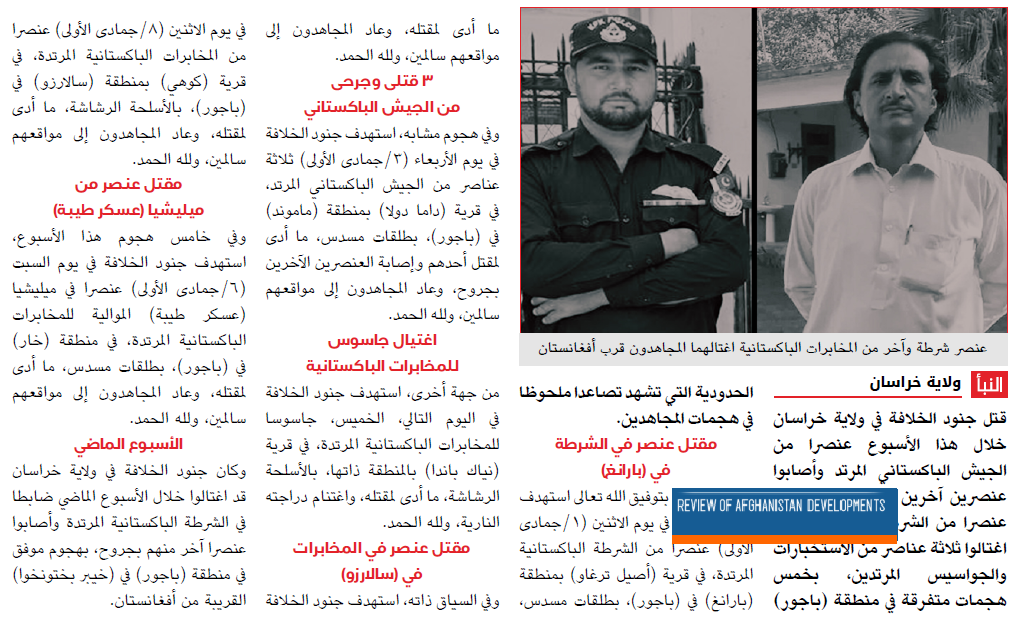
In just 21 days, ISIS-Khorasan has claimed responsibility for eight attacks in Pakistan. The attacks took place between October 3 and October 24 (11 Mehr to 2 Aban). A close look at ISIS statements on the group’s attacks in Pakistan shows that most of its operations have been in Khyber Pakhtunkhwa province, particularly in the Bajaur area. The basic question is why ISIS attacks in Pakistan have grown, and how that growth should be interpreted. Answering it requires an understanding of ISIS, its operational geography, and the region’s security conditions.
Targets of ISIS Attacks in Pakistan
The targets of ISIS attacks in Pakistan can be sorted into three main categories:
● Pakistani security and state forces, including soldiers, police, and local officials
● Rival religious and political activists and clerics, particularly members and supporters of Jamiat Ulema-e-Islam (Fazl faction)
● People ISIS accuses of cooperating with Pakistan’s intelligence agencies
This variety of targets shows that ISIS attacks in Pakistan go beyond a purely security conflict and carry complex political and religious dimensions.
ISIS-Khorasan vs. ISIS-Pakistan
ISIS-Khorasan was founded largely by members who had split from the Pakistani Taliban (TTP), and as it developed it gradually ran into internal disputes over operational priorities. Some members with Pakistani backgrounds wanted to focus on operations inside Pakistan, while the group’s leadership preferred to treat Afghanistan as the main theater and move toward more global aims.
The disagreement over where to fight steadily intensified. Finally, in spring 2019 (May 2019), ISIS’s “central council” announced through its official outlet, Amaq, that it was establishing the Pakistan Province (ISPP) and separating it from ISIS-Khorasan. The decision reflected direct intervention and arbitration by ISIS’s central leadership (with ISIS representatives from Syria mediating) in the Khorasan branch’s disputes, and aimed to ease internal tension by elevating the Pakistani section into an independent “province.”
After the split, the two ISIS branches operated in the region with a clear geographic division of labor:
● ISIS-Khorasan (ISKP) took primary responsibility for operations in Afghanistan and in Pakistan’s Khyber Pakhtunkhwa province, since this area is the group’s historical core
● ISIS-Pakistan (ISPP) took responsibility for operations in Punjab, Sindh, Balochistan, Islamabad, and Kashmir
Why Did ISIS Attacks in Pakistan Increase?
According to evidence-based reports and analyses, after military pressure from the Taliban government, ISIS-Khorasan pulled most of its commanders and fighters out of Afghanistan in order to survive, and some of them moved to Pakistan. Under the security theory of the “displacement effect,” ISIS-Khorasan has, since this migration, displayed its operational capacity in part of its operating geography — Khyber Pakhtunkhwa province. In this framework, a “decline in attacks in Afghanistan and a rise in ISIS attacks in Pakistan” is an expected outcome.
Field evidence supports this hypothesis well. Figures published by the United States Institute of Peace, citing ISIS’s weekly magazine al-Naba, show that the number of attacks in Khyber Pakhtunkhwa rose from:
● 7 in 2019, before the Taliban came to power in Afghanistan
● 47 in 2022, when Taliban military pressure on ISIS began
This rise in ISIS attacks in Pakistan is consistent with the logic of the displacement effect. The recent show of capacity in the Bajaur area of Khyber Pakhtunkhwa province can therefore be understood as an adaptive response under conditions of survival: ISIS-Khorasan is compensating for the loss of operating space in Afghanistan through frequent, small-scale activity in Pakistan, and in doing so demonstrates its continued existence and its ability to pose a threat.
How Pakistan’s Security Disorder Fuels the Rise in ISIS Attacks
Pakistan is currently grappling with layered security, political, and economic crises. The federal government’s security focus has been largely on containing the Pakistani Taliban (TTP), and this one-sided focus has opened up room for maneuver for other groups. Historical experience shows that ISIS typically grows where states face crisis and structural weakness — as we saw with the group’s growth in republic-era Afghanistan. In Pakistan too, the central government’s weakness in fully controlling border areas, security vacuums in the tribal belt, and internal political rivalries have created fertile ground for the rise of ISIS attacks in Pakistan.
Related Articles
ISIS Khorasan’s migration from Afghanistan to Pakistan
The new role of ISIS Khorasan in the region
Conclusion
The rise in ISIS attacks in Pakistan, and their concentration in Khyber Pakhtunkhwa province, is a direct result of military pressure on ISIS-Khorasan in Afghanistan and of the displacement effect at work. By moving some of its forces to Pakistan, the group tried to preserve its existence, and to prove it is still alive it carries out operations in the suitable environment of Bajaur, in Khyber province. This development isn’t happening in a vacuum: layered security, political, and economic crises in Pakistan, and the government’s exclusive focus on the Pakistani Taliban, have provided the ground needed for the rise of ISIS attacks in Pakistan. If Pakistan’s government, instead of focusing on a single group, doesn’t move toward a root-level resolution of its security crises and filling the vacuums in border areas, it should expect ISIS’s attacks to spread to other provinces too.
There are signs that Pakistan is managing the situation so that ISIS-Khorasan’s attacks return to Afghanistan, which has raised the Taliban government’s concerns. Gul Hassan Hassan, the Taliban government’s ambassador, said at a joint security conference of the Collective Security Treaty Organization, the Commonwealth of Independent States, and the Shanghai Cooperation Organization on Central Asian and Afghan security issues, held in Moscow, that Pakistan is trying to shift ISIS into Afghanistan.
A. Azizi is a Kabul-based analyst of security and political affairs, focusing on Afghanistan’s political and security developments, regional geopolitics, and their evolving dynamics. At the author’s request, the author’s identity is not published.