
Review of Afghanistan developments
The introduction of new restrictions and the strengthening of enforcement mechanisms concerning women’s attire, which triggered the Herat protests, cannot be understood merely as immediate responses to a particular policy. While the recent limitations on women’s clothing and their social participation are acknowledged as the primary catalysts for the Herat protests, it is also essential to consider that these occurrences stemmed from a foundation of long-standing discontent, identity disparities, social marginalization, relative deprivation, and systemic conflicts.
From this perspective, the recent demonstrations by the residents of the Jibraeel region in Herat represent more than just a fleeting response to a government order; they signify underlying social and political dynamics that have developed within Afghan society over the past few years.
Following the reinstatement of the Taliban, Afghan society has entered a period of power reorganization, resulting in significant repercussions not only within the political realm but also across cultural, social, and identity dimensions. The centralization of authority, accompanied by a particular interpretation of political and religious structures, has constrained avenues for social engagement and diminished the representation of various groups in decision-making processes. In this context, emerging gender policies ought to be examined not as standalone occurrences, but rather as integral components of the broader system that perpetuates the political and social order.
Reproduction of the power structure
One significant theoretical framework for examining recent developments in Afghanistan is conflict theory. This perspective posits that society functions as a battleground for competition and conflict among various groups vying for power, status, and social resources. From this standpoint, social order emerges from the dominance of groups that have successfully acquired power resources and imposed their preferred values and norms across society.
In contemporary Afghanistan, the political framework exemplifies the concentration of authority within a particular ideological and political paradigm. The limitations placed on women in this context extend beyond mere cultural or religious policies; they serve as instruments for manifesting and perpetuating the desired governance order. Viewed from this angle, the contention surrounding the hijab or women’s participation in society transcends the issue of attire, encompassing the right to choose, the extent of governmental interference in daily life, and the definition of women’s roles within the social hierarchy. Consequently, gender restrictions often carry significant symbolic weight and can emerge as critical battlegrounds for social and political conflict. The regulation of women’s clothing, social engagement, and gender roles can be perceived as mechanisms for reinforcing political authority and controlling the public domain.
From this viewpoint, the demonstrations in Herat opposing stringent regulations on women’s hijab reflect deeper issues related to the allocation of power and the potential for societal involvement.
The impact of the accumulation factor of social dissatisfaction in the Herat protests
In addition to conflict theory, the theory of relative deprivation offers a crucial framework for comprehending recent developments. This theory posits that social protests do not solely stem from absolute poverty or economic downturns; instead, they arise when there is a considerable disparity between individuals’ expectations and their current circumstances.
Numerous social groups in Afghanistan, irrespective of gender, have faced a significant reduction in civil liberties, social engagement, educational access, visibility in the public domain, and interaction with the global community, particularly over the last twenty years. The abrupt limitation of these opportunities may intensify feelings of lost status and lowered social standing. In these situations, even if the material conditions of certain groups remain largely unchanged, the perception of restricted opportunities and narrowed social prospects can serve as a catalyst for protest activities.
The role of political marginalization in the Herat protests
The notion of social exclusion serves as a crucial analytical instrument for comprehending the present circumstances in Afghanistan. Social exclusion denotes a process through which certain groups within society are progressively denied access to political, economic, social, and cultural opportunities.
In situations where formal avenues for political engagement are restricted and the capacity of various groups, such as ethnic minorities and women, to actively partake in decision-making is diminished, certain segments of society may experience feelings of underrepresentation within the power framework and a profound sense of exclusion from the public domain. This perception of marginalization can foster the development of protest identities and enhance solidarity within the group.
In this context, this element can be regarded as one of the fundamental causes of the recent protests, alongside other factors, and as a response to the feeling of exclusion. For certain protesters, the issue transcends merely opposing the restrictions placed on women; it represents, at a deeper level, a protest against a wider phenomenon of political and social exclusion. Consequently, gender politics emerges as a representation of the comprehensive experience of exclusion.
The complexity of the situation is heightened when social exclusion intersects with other established divisions within society. In Afghanistan, the limitations placed on women have arisen amidst a backdrop of already existing ethnic, political, religious, and social divisions. When social groups perceive a lack of access to public power, resources, and opportunities, and when new restrictive policies impact their daily existence, the probability of isolated grievances escalating into widespread protests rises.
This matter is especially intricate for the Shia and Hazara communities in Afghanistan. While certain factions and individuals associated with this community have engaged with the current government, their historical experiences of discrimination, religious disparities with the ruling authority, security apprehensions, diminished representation in the power hierarchy, and limitations on fundamental citizenship rights have laid the groundwork for social discontent within this community. When individuals or groups perceive themselves as lacking the necessary capacity to influence political and social decisions, and when citizens feel they lack effective avenues for participation and that their voices are disregarded in decision-making processes, a pervasive sense of powerlessness can take root in society.
In today’s Afghanistan, the significant concentration of political authority alongside a scarcity of intermediary institutions has resulted in segments of society feeling that altering policies through formal channels is unfeasible. This situation can foster political apathy on one hand while simultaneously laying the groundwork for symbolic protests on the other. Nonetheless, these symbolic protests typically do not seek to effect immediate changes in the power structure; instead, they aim to expose underlying grievances and reshape the collective identity of the demonstrators. In this context, protests originating from gender issues can be connected to wider demands encompassing ethnic identity, political engagement, equal citizenship, and social justice.
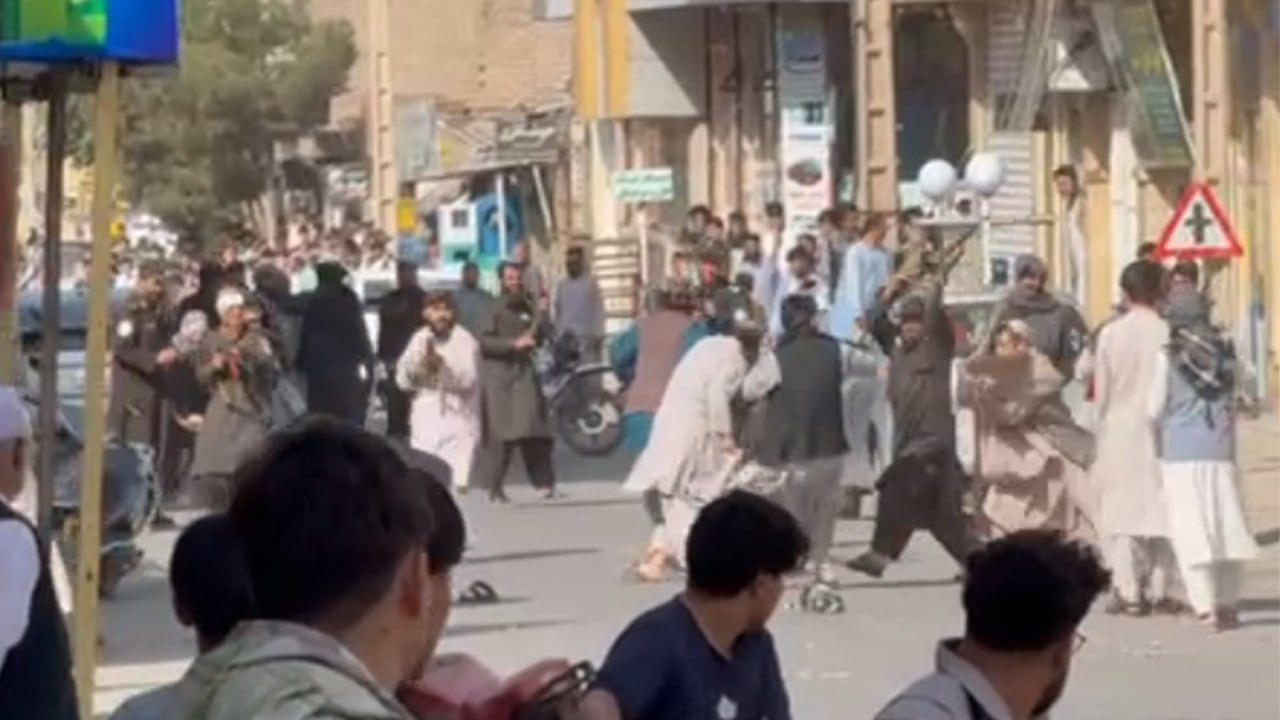
On the other hand, the alignment of the Herat protests with international meetings and discussions concerning Afghanistan holds significant relevance. During such periods, various stakeholders endeavor to promote their interpretation of the situation in Afghanistan on a global platform. In this context, social protests transcend mere domestic occurrences; they are integral to a larger contest to shape the political narrative of Afghanistan. Different entities, including protest groups, international media, human rights organizations, and the government, strive to assert their own perspectives on the prevailing circumstances. Viewed from this angle, protests serve a dual purpose; they not only articulate domestic discontent but also engage in international discursive rivalries, wherein the influence of media and cyberspace is crucial. In modern societies, the significance of an event is not solely gauged by the number of participants or the scope of its impact, but rather by how it is portrayed in the media, which plays a pivotal role.
International media, social networks, and digital activists possess significant power to bring attention to events, particularly regarding women’s rights and minority rights. Consequently, the level of media coverage of a protest may far exceed its actual impact within the social sphere. This phenomenon can be understood through the disparity between social reality and media portrayal. In such scenarios, the representation created in cyberspace may not accurately reflect the true significance of an issue within society. Nevertheless, this media emphasis can lead to substantial political and social ramifications, such as capturing the interest of global public opinion, bolstering transnational solidarity, and intensifying pressure on governmental bodies.
Related Article
Badakhshan protests and the poppy cultivation crisis
Conclusion
Ultimately, the recent changes in Afghanistan cannot simply be distilled to new limitations on women or sporadic protests in certain locales. Events like the protests in Herat arise from the interaction of a variety of structural factors, including the concentration of power, ethnic divisions, relative deprivation, social exclusion, feelings of political impotence, and new trends in media representation. The restrictions on women can be regarded as a primary driver of a process that has deeper roots in Afghan society. At the same time, segments of society that feel marginalized or excluded view these policies not merely as gender restrictions, but as representations of a larger process of social and political exclusion.
Nevertheless, the power structure in Afghanistan indicate that protests, regardless of their persistence, may not result in immediate alterations to government policies. Thus, the primary importance of these occurrences should be found not in their short-term effects on governmental decisions, but in their ability to expose social rifts, reshape collective identities, and perpetuate symbolic struggles concerning power, gender, and ethnicity in modern Afghanistan. Consequently, this form of governance, where a single ethnicity at the helm seeks to strengthen its authority by marginalizing other ethnic groups, has proven ineffective over time, as evidenced by Afghanistan’s historical governance patterns.